Showing posts with label Tom Jones. Show all posts

Wednesday, 25 April 2012

Book to Film: The ‘I’ and The ‘Eye’

Guest Post by Lynn Shepherd

First person narration has always been a tricky beast. Slippery to read, and, believe me, even harder to write. We can all name books that are told to us by one of the main characters, some of whom turn out to be - in that famous phrase – ‘unreliable narrators’. Narrators who don’t tell us everything they know, or withhold key facts only to spring them on us later, or – as in The Murder of Roger Ackroyd, one of the most celebrated examples – actually turn out to have been the killer all along.

Of course you can’t do that on film, or not very elegantly, anyway. Having an actor address the audience direct is a rather cumbersome device these days. It worked fine for Shakespeare, but modern viewers tend to find it grating after a while, and rarely suspend their disbelief that all the other actors can’t hear what’s being said as well.

So how does a screenwriter translate a book written from such a personal viewpoint into a viable film, and what do we, as viewers, lose or gain by the exchange?

I’m going to talk a bit about Bleak House here, and in particular that very fine BBC 2005 adaptation. Partly because Bleak House has a distinctive ‘double narrative’ structure which raises its own special challenges for the screen, and partly because I’ve echoed that structure in my own book, Tom-All-Alone’s/The Solitary House.
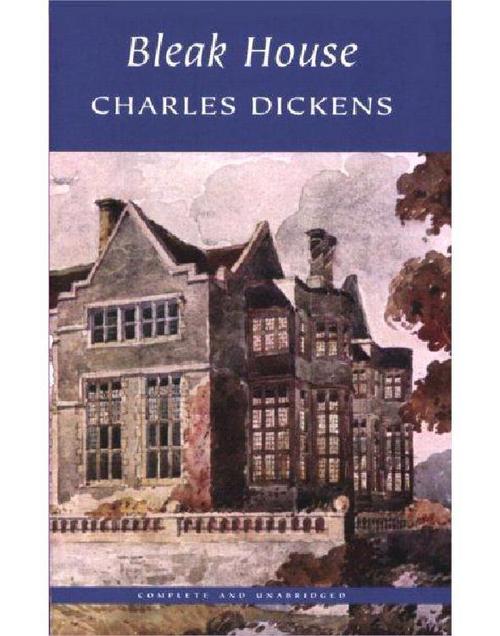
Bleak House is told by two people. One is a voice that we inevitably assume to be Dickens’ own – it’s written in the present tense and is forceful, energetic, and unflinching in pointing out the social evils of the day. The other voice is Esther Summerson’s, telling us the story of her own life as she looks back on the past. But the very fact that she’s looking back means she’s in possession of the ‘secrets’ of the story before she even starts, but we’re not given that information until it emerges in the course of her tale.

In Bleak House these two stories remain largely separate throughout most of the novel, though some characters do appear in both accounts. It’s not till very late on, as the book reaches its climax, that ‘Esther’s past’ and ‘Dickens’ present’ come together in one narrative. The first task for the screenwriter, then, is to fuse these two stories from the start, so that there’s one driving storyline. But of course there’s a price to be paid for doing that. By imposing the one ‘eye’, you lose the subtleties of the two ‘I’s.

One obvious example would be the death of little Jo, the crossing-sweeper, in the book, where Dickens famously steps back at the end of the scene and addresses the audience with a very typical tirade:

Dead, your Majesty. Dead, my lords and gentlemen. Dead, right reverends and wrong reverends of every order. Dead, men and women, born with heavenly compassion in your hearts. And dying thus around us every day.

How do you deal with that on screen? The 2005 adaptation (like others before it) has Mr Jarndyce actually speaking a version of those words, though not directly to camera, more as a voicing of his own private thoughts. That’s undoubtedly quite a tidy and practical solution, though it does come over as a little strained and unnatural. So how else could you do it? There was a very fine version of Tom Jones back in 1997 that had Henry Fielding wander into view every now and again, and talk about what was happening in the plot. That worked particularly well because Fielding is such an interfering narrator on the page, so having him do the same on pixels was a lovely light and witty touch. And they got round the ‘everyone can overhear’ point by freezing the action and having him wander about in a tableau of his own creations. Delightful.

And it has to be admitted that screen versions can do some things no writer ever can. For example, the only way Dickens can convey to us that Allan Woodcourt is attracted to Esther is by having her – in effect – tell us so, but it’s hard to bring that off without making her seem rather winsome and falsely modest. TV, on the other hand, can dramatise all the little nuances of glance and gesture that two people communicate to one another, and allow the viewer to draw their own conclusions. In fact, I think one of the reasons Esther works so much better on screen is the very fact that we don’t have to listen to her repeating all the praise people heap on her – TV shows us her actions and allows us to form our own judgment.

So – in short – there’s no one simple answer (is there ever?). The ‘I’ of a book will always give you the richer and deeper experience of its narrator, if only because you spend so much more time with them that way. But in the hands of a great film-maker, that character can come to life on the screen – can reveal new depths and complexities, and bewitch your watching ‘eye’….

- Lynn Shepherd


Lynn Shepherd’s novel Tom-All-Alone’s is out now in the UK from Corsair, and is published 

in the US and Canada on May 1st under the title The Solitary House


To win your own copy, check back with Film vs. Book next Tuesday 1st May for competition details...


Monday, 5 March 2012

Five Literary Greats and Five Great Adaptations

Guest Post by Lynn Shepherd

Lynn Shepherd is the author of Murder at Mansfield Park and Tom-All-Alone's. A massive fan of classic literature, here she talks about her favourite adaptations of some literary greats.
_______________________________________________

When the nominations were announced for this year’s Oscars, one of the first things the media noticed was the number of nominees that were based on books. Eleven films shortlisted in the major award categories, and two-thirds of the Best Picture candidates were literary adaptations, including War Horse, The Descendants, and The Help.
So with that in mind I’ve compiled my own shortlist of screen dramatisations, and since my favourite reading is classic novels I’m going to concentrate on film and TV versions of some of the masterpieces of English literature. So, here we go, counting down from number 5…
5:         Henry Fielding – Tom Jones
The version I’m nominating here isn’t the famous ‘60s film with Albert Finney (and that eating scene), but the 1997 BBC adaptation starring Max Beesley. Having such a famous predecessor could easily have overshadowed the TV series, but Simon Burke’s script translates Fielding’s busy boisterous book into a light-hearted, exuberant, sexy series. The thing I particularly love is the way they freeze the action every now and again, and let Henry Fielding wander on-screen and talk to us about what’s going on – it exactly captures the novelist’s intelligent, intrusive style of narration (and John Sessions is perfectly cast to do it).

Special acting honours: Brian Blessed is a hilariously rumbustious Squire Weston, complete with pack of scruffy smelly hounds - he clearly had a ball making it.

4:         Thomas Hardy – Jude
Jude the Obscure is Hardy’s darkest novel, and this film certainly doesn’t flinch from the book’s desolate subject-matter. To quote one of Hardy’s most famous poems, the whole film is shot in ‘neutral tones’, as the tragedy of Jude Fawley’s thwarted ambitions and his doomed love for his cousin Sue plays out against an Oxford greyer and grimmer than Morse ever made it. But if you prefer your Hardy a little less heart-rending, then the 2003 ITV Mayor of Casterbridge is also excellent.

Special acting honours: Kate Winslet, for her portrayal of Sue Bridehead. Every bit as magnetic and mercurial as Hardy’s original.  

3:         Jane Austen – Persuasion
When Murder at Mansfield Park came out and I was doing the rounds of festivals and book clubs, there was one question I knew I’d be asked every time: ‘Which is your favourite Austen adaptation?’ And the answer – then and now – is the 1995 BBC Persuasion with CiarĂ¡n Hinds and Amanda Root. This version is just perfectly pitched – the production values are as high as you would expect from the BBC, but they also get some of the trickier period details absolutely right. The most obvious is the use of candlelight for evening scenes – far too many Austen balls are lit impossibly brightly (literally, given the lamps available at the time). The adaptation is also very skilful – I particularly love the (very funny) sequence in which each of Anne’s relations corner her one after the other to complain about each other. It’s a perfect example of how you can make witty prose into clever drama.

Special acting honours: There are almost too many to list here, since part of the strength of the production is the ensemble acting. Fiona Shaw and John Woodvine make a particularly touching Admiral and Mrs Croft – all the more so since these two characters are (dare I say it) rather lifeless on the page. And Corin Redgrave is a deliciously self-centred Sir Walter.

2:         Charles Dickens - Bleak House
I think Bleak House is without question Dickens’ finest work, and it’s the inspiration for my own Victorian murder mystery, Tom-All-Alone’s. So as you can imagine, I’m particularly demanding when it comes to adapting this one for the screen. But this BBC version scarcely puts a foot wrong. And let’s not underestimate the scale of the task – Bleak House is a huge book, with a huge cast of characters, and innumerable sub-plots, so turning that into coherent and compelling TV was a real challenge. One way they achieved this was by adopting the ‘soap opera’ structure of half-hourly slots, which worked well for a modern TV-watching audience, but also – and delightfully – echoed Dickens’ own serial publication method, complete with episode-ending cliff-hangers. My only reservation – and it’s a relatively minor one – is that Charles Dance is hopelessly miscast as the lawyer Tulkinghorn: he’s too attractive, too young, and far too damn tall.

Special acting honours: Phil Davis is (as ever) excellent as the wicked wizened old Smallweed, but the ultimate accolade has to go to Gillian Anderson. Like many other people, I was surprised and a bit sceptical when her casting was initially announced, since it looked too much like a blatant attempt to woo the US audience, but she proved me triumphantly wrong. She was perfectly aloof and glacial as Lady Dedlock, just as she was eerily beautiful as Miss Havisham in the recent Great Expectations.


And the winner is….

1:         Samuel Richardson – Clarissa
Richardson is a great literary hero of mine, and I think it’s a huge shame so few people now read him or (let’s be honest) have even heard of him. But that, dear reader, is exactly what a good screen adaptation can do. Clarissa was first published in 1748, and tells the story of Clarissa Harlowe, tricked away from her oppressive parents and eventually raped by the libertine Robert Lovelace, who is in my opinion one of the great creations of European literature. The book is told entirely through letters, and if that weren’t challenging enough for a modern adapter, it’s over a million words long. This BBC version compresses the action into three brilliant hour-long episodes that portray the stifling oppressiveness of the Harlowe family house, the increasingly unsettling atmosphere in the London house Lovelace takes Clarissa to, and the full horror of the final rape scene, which in the novel takes place ‘off stage’. A truly marvellous book, turned into equally marvellous TV, and I can’t recommend either highly enough.

Special acting honours: Sean Bean is utterly mesmerising as Robert Lovelace, capturing his dangerous charisma with amazing skill. As his feelings for Clarissa contend with his baser impulses, you can actually see that conflict written across his face in tiny but terrifying changes of expression. And, needless to say, he looks absolutely magnificent in a pair of breeches….

Lynn Shepherd’s new book Tom-All-Alone’s is out now from Corsair and will be published in the USA by Random House under the title The Solitary House in May. Her website is www.lynn-shepherd.com