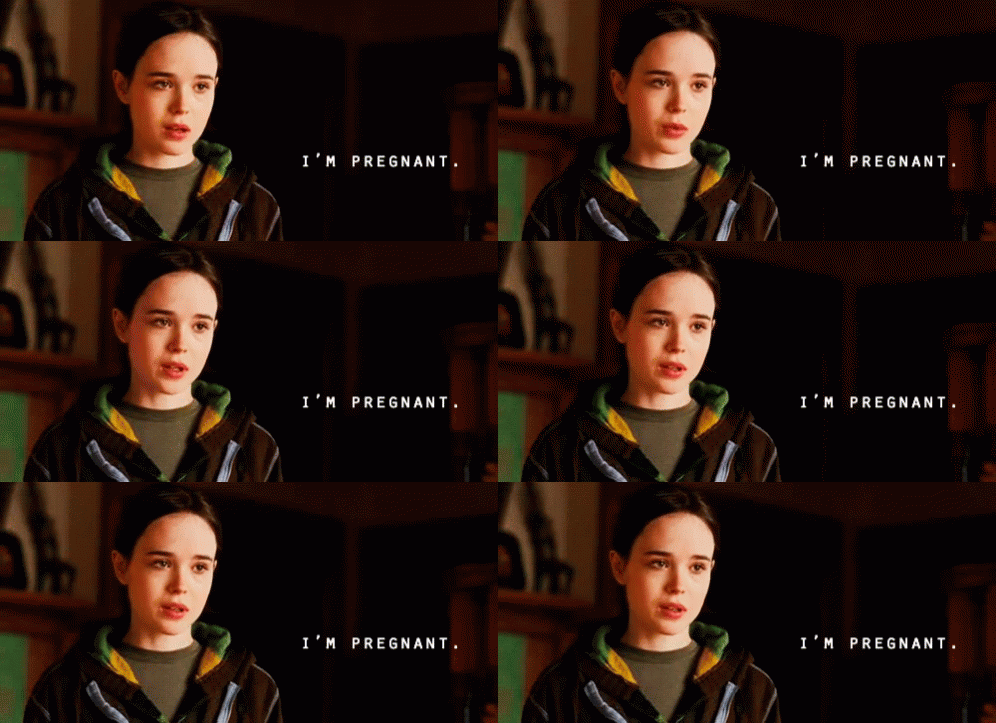
Juno, written by Diablo Cody, sees a teenage girl fall pregnant and decide to give the baby up for adoption rather than have an abortion. With the support of her friends and family, she navigates the challenges of pregnancy and the impending knowledge that she will be giving up her child.
The film quickly became a cult classic and it's easy to see why. With a witty script, brilliant music and a plot that remained light and adorable whilst not overlooking the repercussions of teenage pregnancy, Juno was a fun and sweet delight with a quirky mix of comedy and sincerity.
The fantastic cast includes Ellen Page, Allison Janney, Michael Cera and J. K. Simmons.
4*
See also: the brilliant 'Tallulah' (which can be found on Netflix). Tallulah reunites actresses Ellen Page and Allison Janney and is written and directed by Sian Heder.
Me Before You was such a successful novel that when it was announced that an adaptation was in the works, fans of the book were caught between hesitation and excitement. Even when the book's author, Jojo Moyes, was announced as the screenwriter, there were doubts. Because, when a book is that loved, you don't want it messed with.
Fortunately, Moyes has proven with this screenplay that she is not just a brilliant novelist but also a great screenwriter, with a spot-on understanding of what works on screen and how to compact her story successfully into a feature film.
If it wasn't integral to the story then it wasn't included in the film. Did Will need to have a sister in order for us to appreciate the issues faced by his family? No. We had his parents for that. Do we need the tension at Lou's house, the sibling rivalry and animosity, or the claustrophobic nature of her home in order to appreciate the family? No. They can be packed into the small house and still be loving and supportive.
Though there are some minor character traits and side plots which are forgotten, the major one that may surprise fans of the book is the total absence of a particular maze and all the events which took place. Now it might seem like a whopping great omission but having revisited the story I can see why it was left out. There is no question that this was of huge importance in the book. It explains Lou and it allows Will to be the one who makes her face up this key moment in her life and start to move forward from it. Yet in the film there simply isn't time. Other elements would needed to have been cut in order to properly go into what happened in that maze or else it would have been thrown in almost as an afterthought. Either option just didn't seem to work. Moyes herself even tweeted a fan, explaining that they tried to fit it in but just couldn't figure out a way to do it properly. The people are still going in the same direction. We're just spared some of the specifics.
The casting is so impressive. Very unlike her Khaleesi role, Emilia Clarke IS Lou. She's cute and adorable and chatty and a little bit bonkers – in the best kind of way. Sam Claflin similarly takes on Will, an extremely complex character, with apparent ease. The supporting cast, from Janet McTeer to Charles Dance, are all equally awesome to watch. And this brilliant ensemble are guided through the story by director Thea Sharrock, who displays the same genius command of storytelling as Moyes. The whole team have really come together here to tell this much beloved story.
It's a delight to see that, after some authors who probably should have been consulted on their adaptations and weren't (and some who shouldn't have but were!), authors are finally being acknowledged for their talents, not ignored. We are in a new era now when authors of great books are afforded not just the courtesy of being consulted on the adaptations of their own stories but the opportunity to write the script themselves. Gillian Flynn did it with Gone Girl, Emma Donoghue did it with Room, and now Jojo Moyes has done a phenomenal job with Me Before You.
So get your bumble bee tights on and go and see this absolute treasure. Then go home and re-read the book!
Book – 5
Film – 4
Unsurprisingly, I had a fair amount to say about the latest Hunger Games film The Hunger Games: Mockingjay - Part 1. So much so that it was spread over a few sites. So here's my round-up.
For a comparison between the book (well the first half anyway) and the film, check out my book vs film review at The Hollywood News.
Light years away from his comedic action hero in This Means War (2012), Chris Pine takes on the dramatic role of Jack Ryan in Jack Ryan: Shadow Recruit as he tries to stop Russia attacking the US and causing total economic meltdown in the process. With his girlfriend Cathy (Keira Knightley) back home suspecting him of having an affair and clearly getting tired of his elusive nature, Jack flies off to Moscow to investigate the origins of the attack.
Soon after he lands, all hell breaks loose and he finds his analyst desk job quickly moving into something more operational. And that's all before his girlfriend shows up to surprise him and becomes part of their attempt to find out what Viktor Cherevin (Kenneth Branagh) is up to. With Kevin Costner as his mentor and Knightley at his side, Pine certainly rises to the challenge of action hero, more Jason Bourne than John McClane. The car chases and fight sequences are impressive and great fun to watch. Though trained as a marine, Jack Ryan is new at espionage. He has the skills to protect himself but manages to include that element of just ‘winging it’ a lot of the time too – something which makes his character that much more endearing.
Despite all the against-type accents (Knightley as an American and Branagh as a Russian), the film is rooted in the action, the script and the characters. As a result, Jack Ryan: Shadow Recruit manages to be an explosive action film with an exciting plot. Being reminded of the 9/11 attacks is a little too much realism for me in a film like this but there are enough car chases to remind you that it really is just well-made fiction.
Film - 4/5 FOBLES
Jack Ryan: Shadow Recruit is released in cinemas on Friday 24th January 2014
It's hard to write a book about death without making readers feel completely depressed and not want to carry on reading - yet somehow Amanda Jennings has managed it with her novel Sworn Secret.
Teenager Anna dies in a tragic accident and her sister, mother and father all deal with her death in very different ways. Jennings explores each of them by switching between perspectives to show the full extent of the
family's despair. In doing so, she perfectly captures the teenage angst of
Lizzie, all-consuming loss felt by their mother Kate and the many ways
dad Jon is just trying to keep everything together.
By adding in the element of mystery, there is a driving force behind the story that makes readers want to continue on even when things get really emotional. And emotional the story does become. It is hard-going at the beginning but necessary. In
order to fully appreciate the events that follow, the reader needs to
see the extent of the family's loss and how each of them are trying to
cope with it in their own way.
Once the mystery element is added, though, and young Lizzie
starts to experience her first love, the pain and beauty of family bonds
becomes that much more important. There is still something missing in the events of Anna's death and her family cannot really deal with her loss until they know what really happened. In the process, of course, they are destroying each other and Lizzie is being ignored in the process. By the time they realise how badly they need each other, will the damage have already been done?
A heartbreakingly real story that is full of emotion with despair and love in the extremes.
Alcohol units - 0 (it's Monday!), cigarettes - 0, calories - no idea, years it took me to read Helen Fielding's hilarious Bridget Jones's Diary - far too many!
Every now and then I do things backwards and see the film before reading the book. In the case of delving into Bridget Jones's Diary, I watched the film, the sequel and the entire 90s series of Pride and Prejudice over and over long before finally purchasing the book and seeing what all the fuss was about. From the opening page, Bridget Jones is a brilliantly 'real' character unlike any I had ever read and the result is a book which is easy, fun and adorable to read. Unlike recent first person stories which have infuriating inner monologues, Bridget is so hilarious and so honest that even when she is moping you want to hug not hit her as she dwells on issues with family, work and of course - her love life.
What a marvellous creation!
For me, the book is an incredibly witty insight into the pressures of life in your thirties and being single - and I cannot figure out why it took me so many years to read the thing! Except perhaps that I needed to be in my thirties to fully appreciate it.
The only let down in the book was that her happy ending involved a guy which - after a book so consumed with trying to be happy all on your own - seemed a little ridiculous. Though I hear the sequel deals with that 'happy ending' rather well...
The film, on the other hand, is a great, silly and enjoyable film which places much more emphasis on the comedic battle between Daniel and Mark - who are both vying for her attention - than the book does. It doesn't forget its star, however, and does a brilliant job of portraying an erratic, on-edge and entirely loveable Bridget Jones.
Played by Renée Zellweger, who famously had to gain weight for the part, the film follows her ups and downs with great fun and sincerity. The mad and totally loyal friends are always on hand, as are the interfering mother and doting father. The mad boss, the embarrasment, the constant attention paid to dieting and alcohol consumption is also relentless.
Though Mark does not appear quite so often in the novel, I don't think anyone could fault the inclusion of Colin Firth and Hugh Grant and that infamous fight sequence. The only part I take issue with is why they altered Bridget's mother storyline which was far more interesting in the novel - unless they had always planned on taking a certain Mark element and plonking it in the middle of the film sequel.
I was pleasantly surprised when I saw the new remake of Carrie and actually really enjoyed it. But how does it compare to the original Stephen King novel on which it's based?
For me, Stephen King is one of the greatest storytellers of our time. In Carrie, his first published novel, King proved he could not only get into the mindset of a teenage girl but that he could also go to incredibly dark places and weave a story together at a slow pace, leading to one of the most shocking endings ever written.
In the novel, King switches between the running story of Carrie and the reports done after the fact. Carrie's story is a tortured one. Firstly, she gets her first period and thinks she's dying, then she continues to struggle to deal with all the bullies at school. On top of that, she discovers that she has telekinetic powers. There's also her self-harming, religious fanatic mother to contend with!
It's a lot for her young shoulders to take but King moves fluidly between her 'present day' story and reports of what has come before. There are interview transcripts and reports from people who met her over the years like the neighbour who spoke briefly to Carrie when she was a toddler. There is more information on Carrie's life earlier life and more explanation as to what happened to her now absent father. By switching between the two, King paints a picture piece by piece and with every page, the reader better understands who Carrie is and her sheer strength at having managed to get this far! The story is not just hers but also that of her classmates: Sue Snell, who grows a conscience and decides it's time somebody did something nice for Carrie, and Chris who wants quite the opposite.
The book really builds to the now infamous explosive finale and, after the prom scene, has one of the most chilling deaths ever written - a death which has been changed for the purposes of both this film and the earlier 1970s version.
The main difference between book and film is that the film pays no attention to the backstory, choosing to interweave the key points - namely the relationship Carrie has with her mother - into the present without looking at the reports or stories found the book. The focus is very much on the here and now and, with it, the fundamentals of the story remain.
A massive change in this remake is that the story has been brought forward to our present day. The horrific bathroom scene which opens the story is now filmed on mobile phones and put on YouTube, something they obviously couldn't have done when King originally wrote the story. It works, however, and makes the film feel that much more current. The plot still resonates today so it makes sense to bring it up to date.
Chloë Moretz and Julianne Moore are both equally stunning in their respective roles as Carrie and her mother Margaret. The horror of both the psychological and physical damage Margaret inflicts on her daughter remains for the film, including one shocking use of a Bible! More is also made of Margaret's self-harming and the loving way in which Carrie tries to calm her moods. Moretz somehow manages to be both sweet and innocent and completely terrifying and handles the role with a maturity way beyond her years.
Overall, the film manages to remain loyal to the original but be brave enough to break new ground at the same time. The book remains utter perfection: endearing, horrifying and chilling.
Carrie is out in the UK Friday 29th November 2013. The book is available to buy now.
Shannon Hale’s 'Austenland' is about one woman’s obsession with Jane Austen, Pride and Prejudice and – to be precise – Colin Firth’s portrayal of Mr Darcy.
This short and easy-to-read novel is an absolute delight to read (and easy to carry on the commute!). The characters are hilarious, especially Jane herself, and the comedy in throwing a modern day American woman into an Austenesque retreat in the English countryside is non-stop. Jane is endearing, despite her ridiculously outdated ideas of love and romance, and it’s easy to warm to her. It really is the perfect, enjoyable read for any Austen fan – especially anyone who fell in love with Firth's Mr Darcy. Your face will ache from smiling. The film adaptation takes a much more slapstick approach to the story and takes the whole setting to more theatrical depths, with the emphasis more on gags than witty banter.
It does provide plenty of laughs but the Austenland story is very specific in its appeal. If you love Austen and are in the mood for something silly it might just work for you. It is, though, incredibly indulgent and the humour (especially in the film) is very tongue in cheek – so much so that many may find it more patronising and insulting than clever and witty. It is a story designed to be taken as it was intended: silly escapist fun.
Ultimately, as the subject of the book vs film club, there were mixed – and extreme – reactions to Austenland in both formats but the difference in opinion certainly made for a more fun discussion than Gatsby, which everyone seemed in agreement over. Film - 3/5 Book - 4/5
Is there anything Stephen King can't do? Apparently not.
For his latest novel, Joyland, King has turned his incomporable writing style to a piece of pulp fiction which follows a young man as he recovers from his break-up, by working at an amusement park.
As is always the case with King's stories, each and every character - no matter how small - is so intricately woven that you care about each relationship, each event.
Joyland is more of a coming-of-age tale than anything else for the most part but throw in a haunted ride legend and a mystery woman with a sick kid and you have every ingredient for a great King tale.
Joyland is endearing, adorable, frightening and it really is a joyous read. 4 FOBLES
Guardian theatre critic and Harold Pinter biographer Michael Billington joined actresses Gina McKee and Lia Williams, writer Nick Payne and theatre director Jamie Lloyd for a special panel discussion of the playwright's work last week, ahead of the production of his play The Hothouse which stars John Simm, Simon Russell Beale and Harry Melling.
The panel discussed the influence of Pinter as a playwright, from the Pinter pause and the real meaning behind what is not said to the importance of timing in his dialogue. Pinter, they said, was revolutionary in the world of theatre and was amongst the first group of playwrights to provide works with ambiguous endings, where audiences could interpret the play the way they wanted to. Every line and every gesture, according to the panel, had significance.
Harry Melling (Lamb) - The Hothouse Photo Credit Johan Persson
The Hothouse follows the staff of a mental health facility as Christmas Day brings the news of both a birth and a death amongst their patients. Chaos ensues as the chief, Roote, starts to panic about the implications of such events taking place under his roof. The play moves at breakneck speed with the dialogue delivered as quickly as a Wimbledon tennis match - flying from one actor to the next and back again. The performances are often manic, adding to the hilarity but, though it is hilarious throughout and provides numerous belly laughs, the play is incredibly dark. The patients are never actually seen but hearing the way the staff talk about them is horrifying. They refer to them in numbers and look at them as an imposition and inconvenience. The news that one of the patients has given birth means that one of the staff has been having sexual relations with her but this reveal is met more with indignation at the extra work the birth has created rather than horror at the relationship itself. The most horrifying scenes are that of Lamb (played by Melling) undergoing electric shock treatment. His performance is so vivid that the result is immensely unsettling.
For the most part, The Hothouse follows a steady rhythm but it leaps, rather unexpectedly, into one of the more shocking and unresolved endings for which Pinter is now so well known. A clever, insightful but slightly disjointed work. 4/5 FOBLES
The Hothouse runs until August 3rd
at Trafalgar Transformed.
Isaac Marion's Warm Bodies quite consciously does not fit into any neat genre box. It is both dark and fun, romantic and twisted, silly and serious. Yet in Marion's capable hands, the story never feels disjointed and flows just as richly as the blood from those being devoured by the zombies. In so many ways, Marion's tale is filled with brains. The story follows a chance encounter between zombie 'R' and human Julie. When R goes on a hunger run with some of his fellow zombies, he is instantly drawn to Julie and feels the need to protect, not eat her. What follows is the development of the relationship between the two, as R tries to become more human and Julie realises that the 'dead' are not as dead as she first thought. It pays close attention to the elements of connection and interaction that makes us feel alive. The book, though often romantic and fun, is set against an immensely dark backdrop where humans have been forced into compounds in order to survive the zombie epidemic that has taken over the world. It raises a lot of questions about the shifting priorities in this dystopian future and the conflict between surviving and really living.
The film adaptation, directed by Jonathan Levine, manages to remain quite faithful to the original text and has two incredible actors playing R (Nicholas Hoult) and Julie (Teresa Palmer). What Hoult manages to capture with such little dialogue is nothing short
of miraculous. It is unsurprising then that Palmer's Julie falls for
him. Hoult has arguably the most expressive eyes seen on screen for years, conveying so much depth with a shrug or a glance. His inner monologue helps, of course, and keeping his narrative was a genius move on the part of the filmmakers. Palmer, in turn, rises to leading lady with class, bringing the hardened edge to Julie that the role requires as well as the intense vulnerability. She is incredibly brave and daring, as much when facing the zombies as when she faces her terrifyingly rigid father - who just so happens to be the general of her compound.
The combination of peril, action, romance and comedy is there in the film, just as it is in the book. The only real difference to the feel of the story is that it is far more heavily weighted on the romance. This, though, is a forgivable shift as the
romance itself is so brilliantly original, it still brings something new
to the table. Another brilliant element to the novel that has found its way into the film is the author's great use of music. In the novel, when R cannot say what he wants to, he uses music to say it for him, often playing Julie records that reveal his true feelings. In the film, this happens to great effect and is mixed with a sublime soundtrack that blends some classic tunes from recent decades which serve to enhance the nostalgic elements of the story. Overall, the tone of the book has been softened for cinema audiences. A lot of what made the book so devilishly dark has been glossed over or ignored entirely and the ending is all just a little bit 'nice'. However, the heart of the book remains, thanks to the same careful character focus Levine showed in 50/50 and the beautifully emotive leads.
While the book has a real crossover feel to it - because it never feels like a young adult novel despite the youth of the two leads - the film does seem to have more of a teen audience in mind. However, the plot is so clever and witty that it will appeal to anyone looking for something a bit new and different. Twilight, this is NOT. Book - 4.5/5 FOBLES Film - 4/5 FOBLES
With Breaking Dawn, Stephenie Meyer brought her Twilight series to a close. The book followed Bella Swan as she marries the love of her life, Edward Cullen, and becomes both a vampire and a mother. With this book, the series took a bizarre turn from the teen angst that had riddled the pages of the earlier three and saw Bella mature into an impressive woman thanks to her new vampiric status. It also offered a shift of perspective for a while as Jacob took centre stage with his wolfpack.
For its adaptation, the book was divided into two films - the first following Bella as she prepared to marry Edward, went on her honeymoon and discovered she was pregnant with his child and the second as she had given birth to their half-vampire, half-human baby and was enjoying life as a newborn vampire herself. Director Bill Condon was on hand for both parts meaning that the feel and flow of the pair worked well together. Part One was all about the romance. There was a stunning outdoors wedding, a honeymoon on their very own island and the opportunity to consumate their new marriage. Bella then gets protective over her unborn child that is - quite literally - sucking the life out of her forcing Edward to turn her before she dies.
Though Part Two begins with a happy Bella (Kristen Stewart) revelling in her new life, the drama begins when Alice sees that the Volturi vampires think their daughter Renesmee is an immortal and are coming to kill her. The most important law of the vampire world is that biting a child is forbidden and the Volturi believe the Cullens have broken this law and must stop them. In order to prove that Renesmee was born, not bitten, Edward (Robert Pattinson) and Carlisle travel the world and enlist all the friends they can find to stand with them against the Volturi. As a result, a whole host of new vampires arrive in the town of Forks from across the globe and Jacob, who has imprinted on baby Renesmee so is forever with them all, finds himself outnumbered by red eyes. In the film, Stewart took to the vampiric Bella superbly, showing just how talented an actress she really is when given the opportunity to (pardon the reference) shine. Pattinson is able to relax a little here too which makes for a much more amusing Edward than audiences have seen previously. He is no longer living in fear of hurting the woman he loves. He now realises that it is her turn not to hurt him (as she is stronger than him!) and relishes watching his wife in action.
Whereas fans of the series had spent all their time thus far observing the world of the vampires from the outside, Breaking Dawn Part Two offers the chance to experience it from the inside. It is a far more adult book than the earlier three, with marriage, pregnancy, parenthood and lots of vampire sex to boot and Condon handles this well, keeping the theme of young love and Bella and Edward's plans of 'forever' at the forefront while allowing his stars to grow up and develop.
While the book of Breaking Dawn went off on such a random tangent that many fans of the series may have found it jarring and peculiar, the final film managed to add the drama and action seriously lacking in the book - and, more importantly, made it credible. It wasn't action for action's sake and in creating a far more spectacular ending to the film franchise, the film managed to surpass the book. What the book lacked in tension, loss and drama, the film more than made up for with some impressive fight sequences and cinematic blood on snow imagery. After the release of the first Twilight book, I don't think anyone could have guessed that Bella would become a vampire, a mother and a wife - not even Stephenie Meyer herself. Though no doubt many fans did enjoy the 'happy ending' of it all, this twi-hard found it massively anti-climactic and all too neat and tidy. The film, however, clarified the book's ending with all the tense action necessary to give the series a fitting end. Book - 3 FOBLES Film (Part One) - 3 FOBLES Film (Part Two) - 4 FOBLES
In January 1952, two young men from Buenos Aires went on an immense road trip on their motorbike 'La Poderosa' with the idea that they would explore as much of the continent as they could. One of these two men would become the face of the Cuban revolution. His name was Ernesto 'Che' Guevara.
The Motorcyle Diaries, Guevara's diary kept on this lengthy journey, takes him across the continent as he meets people of all cultures and classes, sleeps on floors, struggles to find shelter, food and transport. More fascinating than all of this, though, is Guevara's search for purpose, his search for meaning. The diaries are written eight years before the Cuban revolution but this is when Guevara's sense of injustice began, it seems. Alongside friend and travel companion, Alberto Granado, the diaries show the major class differences across the continent, the feelings toward those indigenous populations who are judged to be inferior by so many and the lengths many go to just to provide for their families - the section where the pair meet people waiting for work at a mine is particularly upsetting. The work is extremely dangerous and the pay is ridiculously low. But, sadly, these people have no alternatives.
On the journey, both Guevara's and Granado's eyes are opened to the world around them. They have led fairly middle-class 'normal' lives in Argentina, studying and socialising - so this is the first time they really experience the world beyond that to which they have become accustomed. They use their trainee medical skills to get letters of recommendations from doctors and medical staff. They stay at leper colonies and meet those unable to get medical attention. Mirroring this, Guevara himself struggles with his severe Asthma - which on occasion grounds him for days on end. The pair are shown great hospitality and care by some but are also scorned and rejected by others.
As well as meeting people from all walks of life on their journey, the pair also experience all the highs and lows of mother nature and witness some stunning, breathtaking sights along the way. Guevara is an incredibly evocative writer, even here in his diary, as he describes in great detail not just what he is seeing but the impact such sites have on him. His reaction when they arrive at Machu Picchu is intoxicating. The book is relatively short, with a forward written by Guevara's daughter Aleida Guevara March and a chronology of his life. It is choppy to say the least, but this is to be expected from a diary. The film, on the other hand, is compelling from start to finish and flows with stunning beauty, thanks to two incredible leads, stunning landscapes and flawless directing from Walter Salles (who recently directed another coming-of-age road movie 'On the Road'). Gael Garcia Bernal is perfectly cast as the young idealist Guevara and pulls off a performance all the more powerful for its subtlety and control. Rodrigo De la Serna also captures all the passion and humour of Granado. Salles has strayed slightly away from the overly political elements of the text, allowing the experiences to speak for themselves and affect audiences as much as they do Guevara and Granado. The Motorcycle Diaries is a fine example of taking a powerful, evocative text and making a simply stunning film that conveys to audiences what the text can only imply. Book - 4/5 FOBLES Film - 5/5 FOBLES
Apocalyptic style stories are usually quite sudden and dramatic. In The Day of the Triffids, most of the world's population went blind overnight. In The Day After Tomorrow, the climate shift is forecast to happen in 100 years and starts happening within half an hour of the film's opening credits. People rush out and clear shelves in supermarkets, buy guns, start looting - chaos ensues.
Debut Author Karen Thompson Walker, however, takes a different approach in The Age of Miracles - a book that is hauntingly realistic in its catastrophe because it happens so gradually. One day, there are 24 hours in a day, then suddenly people notice there aren't. The days have slowly been getting longer because, people realise, Earth's rotational pull has been slowing down.
This isn't a terrifying and sudden battle for survival. Nobody knows the effects this 'slowing' is going to have on the planet and governments and the people of Earth try to adapt to the new way of things. There is, after all, nowhere to run to avoid this impending catastrophe. It reaches every corner of the globe.
The Age of Miracles looks at these gradual changes through the eyes of a girl on the cusp of her adolescence, from the moment it was announced to the world. As the world adjusts in whatever ways they can, Julia - our guide - notes what she observes around her while dealing with the awkwardness of talking to boys, buying a bra and the everyday struggle to find happiness. She is as much in the dark as the adults and is learning as she goes, about the slowing and about herself.
The days get longer and so do the nights. Before long, the sun is up for more than 24 hours straight and people are struggling to keep going. New time-keeping measures are put in place which divide communities. Plants begin to die, birds struggle to stay airborne and people struggle to cope with the dramatic shift in their sleeping patterns.
This is certainly a debut worth looking out for. With beautiful flowing prose and not a sentence of preachy, sanctimonous drivel in sight, The Age of Miracles will politely make you think twice about leaving lights on unnecessarily, putting TVs on standby or complaining about a little rain. It will make you appreciate daylight - no matter how cloud-filled the sky may be - and the darkness that comes with the setting sun.
The Age of Miracles is not an action-packed disaster story, rather it looks at Julia and the people around her as they are forced to change what they know; adapt or die. A beautiful, compelling and utterly intoxicating debut.
4 FOBLES
The Age of Miracles will be published in the UK in June by Simon & Schuster - it is available to pre-order now.
The Lucky One by Nicholas Sparks is the story of Logan Thibault, a marine who has lived through three tours in Afghanistan thanks - he believes - to a photo he found during his first tour. The photo is of a woman he doesn't know and clearly belongs to another marine but after having no success finding the photo's owner he keeps it. His best friend Victor convinces him that the photo is his lucky charm and when he returns home he sets out to find the woman in the photo and thank her.
When he tracks down Beth however, he doesn't know how to explain what's happened and keeps the photo secret, instead taking a job working at Beth's family-run kennel. The longer he stays there, the more time he spends with Beth, her young son Ben and grandma 'Nana'. Though their first meeting is a frosty one, Beth and Logan are both surprised by how quickly they start to care for each other.
Beth and Logan are damaged individuals. Sparks knows how to write flawed people who are surprised when good things come their way, having become accustomed to the bad. It makes the passion of the impending romance all the more powerful and the drama that much more heartbreaking. For Logan, he has fallen out of touch with reality, traumatised by his experiences at war. He has become quiet and introverted, unable to really speak to people and relate to them in any real way. He walks everywhere with only his dog for company. Beth, having married young and divorced soon after is raising her son as a single-mother. Her relationships since her ex-husband have been short lived and she has given up on finding love.
The book is typically Sparks - passionate, all-encompassing and with a beautifully honest and heartbreaking romance at its core. The brilliance of Sparks's books is that, detailed as they are, they are often beautifully simplistic in the fundamentals. The characters have been thought out and the stage set well but the story itself is not altogether complex. Being an easy read does not equate to dumbing down and Sparks recognises this, keeping it to the point and just enough to whet the reader's appetite and keep the reader along for the ride all the way to the end. His stories remain compelling from start to finish and are never patronising.
The brevity of his books go a long way to explaining why they are so suitable to being adapted, as is evident in the latest in an ever-increasing line of Nicholas Sparks book to film adaptations. Luckily, their brevity also means that we are unlikely to ever get a part one and part two adaptation!
The Lucky One film sees High School Musical star Zac Efron transformed in the role of Logan with relative newcomer Taylor Schilling as Beth and support from Blythe Danner as Nana. The casting first of all was spot-on. Efron has clearly done his research for the film, meeting marines and learning how war has affected them. There is also a notable physical difference to show him as the marine. High School has certainly graduated. Schilling has risen well to the role of leading lady, showing the strong and vulnerable sides to Beth perfectly.
For me, the book was an ensemble effort. Though the story clearly revolves around Beth and Logan and their impending romance, the book spent a lot of time looking at Clayton - Beth's ex-husband - and allowed Ben and Nana to play important roles. In the film, the romance is the key with the others all taking a side seat to their two leads. Jay R. Ferguson, who plays Clayton, is suitably menacing but never really gets to show off just how nasty he really is, with a lot of his back story and the brilliant opening chapter of the book left out entirely. Logan's best friend Victor also gets a much tinier part and the effect his friendship had on Logan is shown only by Logan carrying his dog-tags with him round his neck. Happily though, Beth's son Ben, who shone for me in the book, is captured brilliantly by newcomer Riley Thomas Stewart. He has all the adorable awkwardness of Ben down perfectly and it's wonderful seeing him come out of his shell with Logan around.
Directed by Scott Hicks, the film has shifted focus slightly, playing up the romance as the only real focus of a beautifully interwoven book plot. The ending, though it kept all the 'important' points, is a little too neat and tidy, leaving absolutely nothing unresolved where the book was brave enough to leave certain elements unknown. However, the stunning setting enhances the beauty of the story and makes it a gorgeous, palatable film with a cast that will keep you hooked throughout in their subtleties and inner turmoil.
A beautiful, dramatic and powerful romance that will easily take even the more cynical reader or viewer along for the ride.
*WARNING: CONTAINS SPOILERS FROM BOOK ONE - THE HUNGER GAMES AND TWO - CATCHING FIRE*
When we left Katniss Everdeen at the end of Catching Fire, she had just made it out of her second Hunger Games in two years only to learn that Peeta had been captured and a rebellion had begun against the Capitol.
Mockingjay picks up with Katniss in a state of mental confusion. She has been so heavily sedated to deal with her breakdown that she struggles to tell the difference between nightmare and reality. The leaders in District 13 are struggling to get her on board as the symbolic image of the rebels' fight and she can barely construct a coherent thought in her head. As she starts to get a grip on reality, the gravity of her absence finally seems to dawn on her and she realises the power she could have in helping the rebels with their cause. But she has her focus on more specific things - finding Peeta and killing President Snow.
Reluctant to be yet another pawn in somebody else's game, Katniss struggles to take orders as her efforts to help those fighting in other districts are recorded and beamed out to the citizens of Panem, showing them and President Snow that she and the rebels are all still fighting. But are the rebels being totally honest with her or just using her for their own gain? Has too much damage been done already for Katniss to ever come back from it? And what are the peacekeepers in the Capitol doing to Peeta?
Where many authors would have picked up this third installment in the trilogy with action and fighting, Suzanne Collins bravely acknowledges the person behind all the action - Katniss Everdeen - and allows her time out of battle to try and deal with what has happened to her. She is filled in on all that she missed while in the arena the second time round and often has relapses into a state of severe agitation and confusion. She is a fighter - there is no question - but in allowing this vulnerability and weakness to shine through, Collins allows the reader time to really embrace Katniss and will her onwards. Then of course, there is the ever confusing love triangle between her and her best friend Gale and fellow victor Peeta. Her worry for Peeta while he is being tortured by the Capitol starts to seem more than just friendly concern and Gale doesn't know how to take it.
Collins kills indiscriminately, much more like Harry Potter author JK Rowling than Twilight author Stephenie Meyer. But she does not kill off her characters lightly. By revealing early on that she is not afraid to kill people off, she keeps the reader guessing. There is no comfort in knowing it will all be alright in the end. You know no such thing. Emotions run high in this final book in the saga and Collins keeps you guessing till the very end as to whether or not it will all have been worth it. Have tissues at the ready for an emotional rollercoaster of a read.
Mockingjay is a gripping and action-packed end to the Hunger Games trilogy fraught with emotion at every stage.
4/5 FOBLES
For your chance to win the entire trilogy you have until Wednesday 29th February to enter the competition over at Novelicious.
We Need to Talk About Kevin is based on the book by Lionel Schriver which, through a series of detailed letters, looks at life through Eva Khatchadourian's eyes as she deals with the aftermath of a school shooting where her teenage son Kevin was the shooter. Through writing to her now absent husband (and Kevin's father) Franklin, she considers who is at fault for Kevin's actions on that Thursday. Is it all her fault? Was the lack of motherly affection to blame? Or was Kevin simply born evil?
Directed by relative newcomer Lynne Ramsay, the film adaptation has won numerous 5* critic ratings, was dubbed Best Film at the London Film Festival and has received praise from audiences the world over. It has been dubbed the film of Tilda Swinton's career and even the poster has a quote from the book's author Lionel Schriver saying "A brilliant adaptation of my novel". This is a lot of hype to live up to when the film has only been out for a week. So does it live up to the hype?
Well yes and no...
All the acting is flawless. Tilda Swinton is stunning as Eva, both as the young mother struggling to connect with her son and post Thursday mother dealing with the backlash and still finding time to visit her teenage son in jail. Ezra Miller is delightfully menacing as Kevin. He manages to be both charming and sinister, capturing with apparent ease the stiff antagonistic relationship with mum Eva in perfect parallel with the easy, dutiful son to dad Franklin (John C. Reilly).
Lynne Ramsay and co have done the absolute best possible adaptation of the book. And therein lies the issue. The book does not lend itself to film adaptations. As the entire book is written in letter format, the reader takes what is said with a pinch of salt. This is, after all, Eva's perception. She insists she spotted things, warning signs so to speak, about Kevin and his behaviour which Franklin disagreed with. But, of course, this is all with hindsight. As she is writing the letters post-Thursday it is easy to see that her version of events may be slightly misleading. How much is she exaggerating or imagining something that never actually happened? You never know. This is, after all, her point of view - not Kevin's and not Franklin's. This ambiguity is what makes the book such perfect literature. Nothing is spelled out for the reader, it is all open to interpretation. In the film, there is no ambiguity. It is still Eva's point of view but with no narrator-style monologue or reference to the letter-writing style of the book, it appears more as fact than opinion.
Also, some of my favourite parts of the book were the scenes in jail where Eva and Kevin talk. The dialogue was so fantastically dry after Eva realises that asking "How are they treating you" and "Are you eating OK" just wasn't relevant any more. She dares to ask questions she couldn't before Thursday. It revealed everything and nothing about their relationship and was gripping from start to finish. I was really looking forward to seeing this on the big screen. Sadly, there is not a lot of this in the film. There are visits but normally they involve the two sitting in silence until visiting hours are over.
The horror of the final section of the book is played very subtly in the film, with flashes of memory popping into Eva's head (and onto the screen) throughout the film and focused shots on Kevin as opposed to his victims. It focuses more on the reactions of the families than the actions themselves, the repercussions of Kevin's actions and what that has meant for all involved. The constant jumps between times are easy to follow, largely thanks to Tilda Swinton's ever-changing hair cuts, and add something to the constant haze Eva is living in. Visually, the use of red lighting went a little overboard in my opinion but I can see why they thought it atmospheric and relevant to the mood of the film.
Overall, the film is beautifully shot, perfectly acted by all and a haunting look at human interaction. It has very cleverly avoided the opportunity to sensationalise the deaths and kept the focus on the characters. A great film - if you like that sort of thing.
For any book lover - there is normally a list of authors they will rattle off as their favourites. The kind of author that would make you buy a book without even looking at the blurb - just because they wrote it.
For me, there is only one - Stephen King is it.
So when I learned that he had written a non-fiction book - part auto-biographical, part lesson on how to be a writer, I thought I had found my perfect book. And I did. It's so well regarded that even my teacher on a copy-editing course recommended it when learning about editing fiction.
The book is incredibly disjointed as King was the victim of a horrific car accident while writing the book. But in King style - it works. He writes with his own specific flair about his childhood, his family, his struggles, his successes. It's a glimpse rather than an extensive laborious look into his life - but what a glimpse.
And for the aspiring writers out there, he writes about his pet peeves, the common errors and what he has learned over the years with such humour and honesty. You never feel like you are being talked down to. He is trying to pass on the wisdom of his experience, that is all. And what experience it is.
For King fans, it's fantastic to see what gave him the idea for the infamous bathroom scene in Carrie, what Nurse Annie really represented in one of the worst times of his life and how writing can be therapeutic if you let it.
And if you are yet to experience the brilliance of Stephen King, I recommend Carrie, Bag of Bones and Misery to start...
Directed by Niall MacCormick and written by newcomer Tamzin Rafn, Albatross is the story of Emelia and what happens to a family who live and work in a beach house when the new cleaner, 17-year-old Emelia shows up. The film stars Sebastian Koch as dad Jonathan, Julia Ormond as mum Joa, Felicity Jones as bookish teenage daughter Beth and Jessica Brown Findlay as the whirlwind Emelia that turns their family upside-down.
Orphaned Emelia has been raised by her grandparents. She is a very forthright character, not afraid to speak her mind - a fact the audience is made aware of quickly as her first encounter with Jonathan is to find him masturbating in his study. Instead of running away and hoping he hadn't heard her (as many would do!) Emelia knocks and stands at the door waiting for his reaction. He tells her she doesn't need to clean in that room. "Are you sure?" she responds. "Seems pretty dirty to me."
Jonathan takes an instant shine to Emelia as she excites him out of his unhappy marriage and writers block. But Jonathan is not the only one who has taken a shine to Emelia. Daughter Beth finds her intriguing and when Emelia is invited to dinner by Beth, Jonathan learns that she is an aspiring writer and offers to teach her creative writing - in secret. After a few sessions of her coming onto him, Jonathan succumbs to Emelia's charms and the two start an affair.
Emelia's two new relationships - with Jonathan and Beth develop simultaneously which is what makes the affair all the more realistic. If Emelia had been friends with Beth first, she wouldn't have considered it. But as she gets closer to Beth, she realises how wrong it is. The fear is not that the parents will split up if the affair is discovered - they are so nasty to each other you want them to break up at this point! - but that Emelia and Beth will end their friendship, a friendship so vital to each of them. This is not just about Emelia teaching Beth how to loosen up - after all, Beth appears to be so into her studies as her own form of escapism from her constantly bickering parents. Emelia is equally impressed with Beth, with her intelligence and quiet determination.
Each character is completely flawed and relatable and the comedic timing of Beth's younger sister Posy is spot-on, offering light-hearted relief amongst the drama. The arguments between mum and dad are hilarious to watch but you know that if they were your parents you'd be shoving ear plugs in just like Beth does. It is this brilliant and perfectly balanced mix between drama and comedy that makes the film such a delight to watch and a gem in British Cinema.
Emelia is a fascinating character, rebellious and outspoken but also caring and desperate to be loved. She clutches to any kind of history she can and struggles constantly with her own identity. She is funny and honest in her ups and downs which makes her immensely likeable. You want her to find happiness and you want her to do well. Watching the impact she has on the family - and them on her - is a thing of beauty.
Albatross hits UK screens on 14th October.
4/5 FOBLES
Pictures: Copyright CinemaNX
For Q&A with star Jessica Brown Findlay and writer Tamzin Rafn click here.