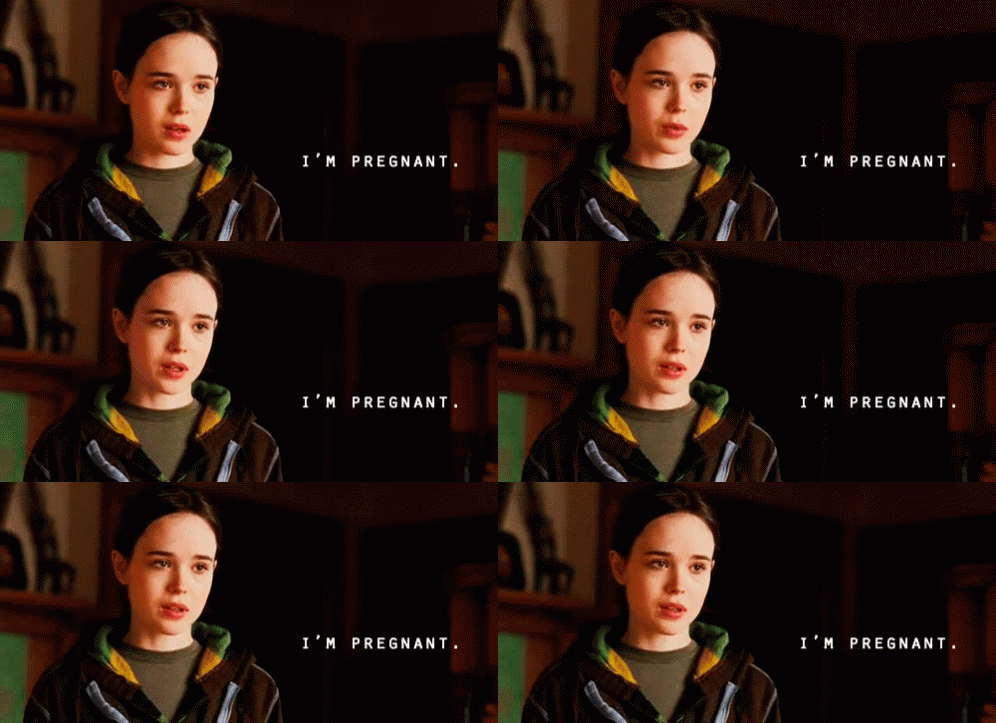
Juno, written by Diablo Cody, sees a teenage girl fall pregnant and decide to give the baby up for adoption rather than have an abortion. With the support of her friends and family, she navigates the challenges of pregnancy and the impending knowledge that she will be giving up her child.
The film quickly became a cult classic and it's easy to see why. With a witty script, brilliant music and a plot that remained light and adorable whilst not overlooking the repercussions of teenage pregnancy, Juno was a fun and sweet delight with a quirky mix of comedy and sincerity.
The fantastic cast includes Ellen Page, Allison Janney, Michael Cera and J. K. Simmons.
4*
See also: the brilliant 'Tallulah' (which can be found on Netflix). Tallulah reunites actresses Ellen Page and Allison Janney and is written and directed by Sian Heder.
Friday, 13 January 2017
Monday, 9 January 2017
Films Made by Women: Point Break, directed by Kathryn Bigelow
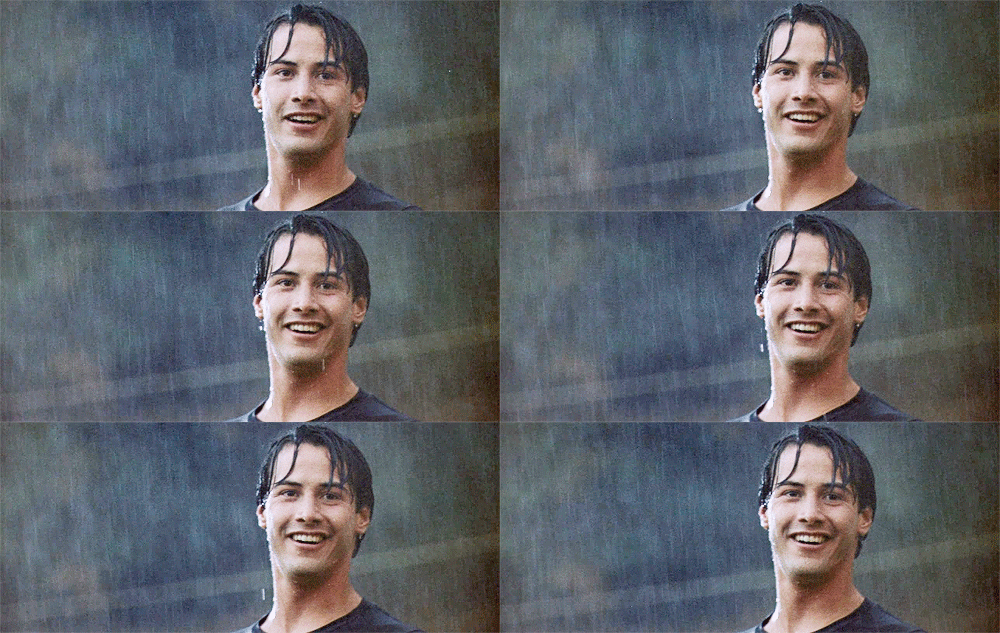
A favourite for many film-fans of my generation, Point Break was one of those films I adored as a teenager (because, hello Patrick Swayze and Keanu Reeves!) and then grew to love even more as I got older and appreciated it for the genius it really is.
That this very testosterone-fuelled film is directed by a woman only makes it all the more brilliant, because it's bold and unapologetic and doesn't fit into any kind of pre-conceived notion of what a film directed by a woman is supposed to look like.
A story of bank robbery and surfing, Point Break is fun, intense, silly and dark. It's beautifully shot: there is some stunning hand-held camera work for an intimate, on-foot chase scene alongside but also equally impressive skydives and surfing sequences. (Swayze does one of the jumps on camera himself!)
Reeves and Swayze are a phenomenal pairing on screen, their performances enhanced by the support of Gary Busey, Lori Petty and the rest of the ex-presidents, and the pace never lulls, blending humour with drama and tension.
Unlike so many action films of recent years, this film blends the action flawlessly with great characterisation, a plot filled with twists and turns (and some quality one-liners!) and the captivating vision of this very talented director.
And there's just enough time left over to throw in a hint of cheese.
Perfection.
5*
See also: The Hurt Locker, Zero Dark Thirty (also directed by Bigelow)
That this very testosterone-fuelled film is directed by a woman only makes it all the more brilliant, because it's bold and unapologetic and doesn't fit into any kind of pre-conceived notion of what a film directed by a woman is supposed to look like.
A story of bank robbery and surfing, Point Break is fun, intense, silly and dark. It's beautifully shot: there is some stunning hand-held camera work for an intimate, on-foot chase scene alongside but also equally impressive skydives and surfing sequences. (Swayze does one of the jumps on camera himself!)
Reeves and Swayze are a phenomenal pairing on screen, their performances enhanced by the support of Gary Busey, Lori Petty and the rest of the ex-presidents, and the pace never lulls, blending humour with drama and tension.
Unlike so many action films of recent years, this film blends the action flawlessly with great characterisation, a plot filled with twists and turns (and some quality one-liners!) and the captivating vision of this very talented director.
And there's just enough time left over to throw in a hint of cheese.
Perfection.
5*
See also: The Hurt Locker, Zero Dark Thirty (also directed by Bigelow)
Films Made by Women: In a World... by Lake Bell
What better way to kick off the Films Made by Women challenge than with a film written and directed by one who also stars in it!
Lake Bell has the mind behind this delightful look into the world of voiceover work and that iconic trailer intro we all know and love: 'In a world...'
In In A World (2013), Bell plays Carol, the daughter of one of the most celebrated voiceover artists in the business who is trying to break into the industry herself. But far from encouraging her to follow in his footsteps, her father is determined that this is a man's world, a man's industry and he won't have some silly woman coming in and ruining it, least of all his own daughter.
There are silly antics along the way, with great one-liners and comedic timing, yet this film is about so much more than silliness. Carol is hard-working, always studying the accents of the people around her and working on improving her own skills, yet she is immediately dismissed by so many people simply for her gender. And when she finally does start to get some success, well . . . you'll just have to watch it and see for yourself.
A funny, self-deprecating film about both living in the shadow of someone who doesn't want to give up the limelight and owning your own voice, In A World is a real treat!
4*
See also: Man Up (written by Tess Morris and starring Lake Bell and Simon Pegg)
Lake Bell has the mind behind this delightful look into the world of voiceover work and that iconic trailer intro we all know and love: 'In a world...'
In In A World (2013), Bell plays Carol, the daughter of one of the most celebrated voiceover artists in the business who is trying to break into the industry herself. But far from encouraging her to follow in his footsteps, her father is determined that this is a man's world, a man's industry and he won't have some silly woman coming in and ruining it, least of all his own daughter.
There are silly antics along the way, with great one-liners and comedic timing, yet this film is about so much more than silliness. Carol is hard-working, always studying the accents of the people around her and working on improving her own skills, yet she is immediately dismissed by so many people simply for her gender. And when she finally does start to get some success, well . . . you'll just have to watch it and see for yourself.
A funny, self-deprecating film about both living in the shadow of someone who doesn't want to give up the limelight and owning your own voice, In A World is a real treat!
4*
See also: Man Up (written by Tess Morris and starring Lake Bell and Simon Pegg)
Films Made by Women: A Challenge for 2017 (and beyond...)
While I have thoroughly enjoyed numerous films by male writers and directors, the balance is still off. Of the films I saw at London Film Festival last year, some real standouts were made by women: Amma Asante's A United Kingdom, Mira Nair's Queen of Katwe and Lone Scherfig's Their Finest (written by Gaby Chiappe). Yet, their wider releases (if they were fortunate enough to get one!) came and went without much discussion.
So my plan is to watch and discuss them, plain and simple . . . and if I can't find any at the cinema then I have some DVDs to go through (see the photo!) and some options on Netflix.
My current Netflix list (UK) includes:
- 13th
- The Reluctant Fundamentalist
- Take This Waltz
- Coin Heist
Friday, 12 August 2016
Scriptwriting: challenging the default - an unconscious bias test
I've grown up aware of gender inequality. I've heard about how difficult it is for female directors and writers to get work. I’ve heard trolls moan about the 'feminazis' pushing their agenda down people's throats every time someone has the audacity to put a female in a lead role in film or TV.
But it wasn't until I started scriptwriting myself that I became fascinated by the process that leads up to these stories and how they're told – and the almost ridiculous things we must add to the script in order to improve things. The TV script I've written is full of diversity and has many female roles. The main character is (shock horror!) a woman. Yet I didn’t set out to write a diverse story – it's just the story I wanted to write. It's essential that the cast is a mixed one.
When I started to investigate scriptwriting in all its glory, I found advice saying that if you're writing a crowd scene, you should specify that half of the crowd are female and that you should specify that there are numerous ethnicities. Don’t just say 'A soldier enters' or 'A police officer enters'. Purposely make them female and non-white from time to time. Because if you don't then the default of White male is likely to appear in the end product, whether that's how you saw it or not.
And it got me thinking about the unconscious rather than the conscious bias. That if you start talking about a doctor, many people might just assume said doctor is a man. Or if you talk about a primary school teacher, the assumption is that she’s cute and wears flowery dresses and glasses. Because people are going to go to their default, whether they mean to or not.
But the fun really begins when you go against your default!
[In the interest of full disclosure, I am White, female, middle-class, London-born and raised. I have also spent time living in Baltimore, Southern Spain and Buenos Aires. That is my bias.]
I opened up this concept to Twitter, beginning with a simple Tweet about what I wanted people to do: 'Right, here goes: I'm going to describe a character. You get a picture of that person in your mind. Then answer questions on next Tweet...'
Before I’d even begun, I realised that telling people you’re doing an unconscious bias test sort of defeats the point a little bit but for me it was more important to make people think about their own default and to question it. And knowing what I was doing forced me to change my own defaults, just to try and make a more interesting story.
I started off with my first character: Show: family drama, small, intimate, psychological. Character: creepy neighbour, introvert, no friends, spying on neighbouring children.
From that one brief Tweet, the character the voters came up with was: male (88%), 30-50 years' old (50%) and White (a whopping 97%!). And what were the people like on this street? Middle class, according to 79% of the people who responded.
Was the neighbour character...— Amanda (@filmvsbook) July 27, 2016
I had not said a thing about the street. It could have been a very poor, working class one and there could still have been a creepy neighbour. It could have been the richest street in England and it could still have worked. But middle-class, White and male just seemed to be the go-to.
Not a single person thought the neighbour could be Black. And only 3% considered that they'd be Asian.
Was the neighbour character...— Amanda (@filmvsbook) July 27, 2016
So let's mix things up a bit. Let's imagine that story again. How about we make the neighbour a woman. Imagine that she is perceived as creepy rather than is simply because she doesn't talk to people, when actually she's just very sad. Make her misunderstood, not sinister. She's looking at the children because her own child died, perhaps. She's introverted because she's too sad to go out and talk to people. Or, alternatively, make her elderly! She just looks at the children because she's longing to go back to her misspent youth and hates that she's old. She has no friends because they've all died, and she knows her turn is coming soon and nobody will mourn her.
Or maybe she's elderly but still really, really creepy!
Let's move the street. Set it in Birmingham, or Leicester, or so many parts of London where 'White' is not the default, where there is a high Asian population, for example. Or make the whole street Asian characters who live in constant fear of the creepy White neighbour who never speaks to any of them.
The possibilities are endless. But the point, of course, is that there are possibilities that don't involve a White, middle-class male.
And so we move on to the second character I described, in a place a little further afield...
You say the story is set in space so where does your head go? Alien? Star Wars? You're probably already imagining your favourite space-age hero/heroine. A leader, possibly a female (thank you, Ripley!). But they're 'freakishly strong' which may suggest that they're male. Because there are strong women but can there be 'freakishly' strong ones? (Of course there can be!) But this 'leader' is crass and of few words. Does this suggest male more than female?Story: action film set in space. Character: a leader, freakishly strong, crass, of few words. Can you picture them? #unconsciousbias— Amanda (@filmvsbook) July 27, 2016
So, who did we come up with? Well, despite the first responses leaning heavily towards this character being a female (thanks, possibly, to the Katniss/Rey-effect!), the final tally made them male (61%), White (50%), with dark hair (53%), ragged/messy in appearance (70%).
This time around, the percentages weren't as high but we still ended up with a White male. 25% thought he was Black, while 10% opted for our leader to be Asian. When it came to hair choice, my own bias came into the potential answers. Because when I thought of a surly, crass leader I thought of John McClane. So I added 'non-existent' and 27% of voters agreed.
And so to our third and final character test...
Film: childhood adventure, set in major city. Character: 12 yrs old, lonely, imaginative, funny, sweet. Brave in made up world, not in life.— Amanda (@filmvsbook) July 28, 2016
And who did we cast here...? Well our lonely, imaginative, 12-year-old is a girl (91%), White (55%), from a pretty financially stable home (70%) and has dark hair.
Unlike our space leader, 20% saw this girl as having her hair dyed a vivid colour (0% considered this a possibility for the spaceman). 27% considered she'd be Black and 18% saw her as Asian. Was this because I'd purposely noted that it was set in a major city? Who can say?
The most fascinating part of this one (for me, at least!) is that only 9% of people saw her as a he. Why was it so unlikely that an imaginative 12-year-old would be a boy? Well, one voter had a suggestion. He explained that it was the use of the word 'lonely' that made him choose a girl over a boy because:
Another voter had her own idea of why this character was lonely:
@filmvsbook odd-one-out, no siblings, sees the world differently than anyone else,... She is sincere and real in a "fake" world— la vie est belle ☆ (@sanfafazey) July 28, 2016
What do you make of these results? Did anything surprise you?
The full Tweet threads for all three character tests can be found here:
https://twitter.com/filmvsbook/status/758285239999459328
https://twitter.com/filmvsbook/status/758337396916228097
https://twitter.com/filmvsbook/status/758636161690664960
(Also, for more on how women are written in ACTUAL scripts, check out @femscriptintros!)
Thursday, 28 July 2016
Musings on a female Doctor Who
Mere days before Matt Smith announced his run as the Doctor was coming to an end, I posted a piece on Yahoo asking the question 'Is it time for a female Doctor?'. When the announcement about Smith's departure landed, the piece suddenly made the Yahoo! home page and - well - all hell broke loose.
Here's the first piece:
Doctor Who: Is it time for a female Doctor?
With Matt Smith to leave his role as the Doctor at the end
of this year, has Alex Kingston's River Song paved the way for a new female
Doctor?There have now been eleven Doctors in 'Doctor Who'. That's eleven Timelords played by eleven men through eleven regenerations. The long-term assistants - though there have of course been men from time to time - have tended to be female. This male Doctor/female assistant dynamic has been the one constant for the cult TV show but in the fifty years since the show began, the roles of men and women have changed in our society. Why, then, have they not changed in the show?
The most recent series have certainly created more 'equal' females for the Doctor, with many of these mere humans risking life and limb and proving to be smart, courageous and always so incredibly loyal.
None has been more equal, though, than River Song. Thanks to Alex Kingston's hilarious, dramatic and often heartbreaking portrayal of the character, a time-travelling, regenerating female is no longer an item of speculation but a reality much loved by fans. River Song knows how to fly the TARDIS, how to hold her own against an alien race (and more often than not - the human race) and has given audiences just as much fun, emotion, excitement and adventure as any male Doctor.
Surely then, now that Matt Smith is leaving the show it's time for the Doctor to regenerate into a woman. After all, his eleventh Doctor initially thought he might be a woman when, having just regenerated, he touched his slightly long hair and cried 'I'm a girl!'. Imagine the hilarity if a new, female Doctor were to be reunited with her wife, River Song! What would Captain Jack make of a woman Doctor? Or Vastra and Jenny? Strax, of course, wouldn't notice a difference. Add to this a male assistant in need of excitement and escape, as they so often are, and there's surely a brilliant pairing ready to provide yet more TV gold.
'Doctor Who' is a show about regenerating - not just the Doctor himself, but the alien worlds, the enemies, the assistants and the special effects. Before it can become tired, the show needs - quite literally - a face lift. Time may be a big ball of wibbly-wobbly timey-wimey stuff but isn't it time we got a female Doctor in the TARDIS?
Doctor Who: Hate-filled and sexist attitudes from fans
ruined the big reveal
With another man cast as the Doctor, why are fans so
reluctant to see a woman take on the role?
Why the vitriolic
reaction to the question ‘Is it time for a female Doctor?’ made the
announcement of Peter Capaldi’s casting in the role so disappointing.
Around the time Matt Smith announced he was to leave ‘Doctor
Who’, an article I had written about the show – in which I asked whether it was
time for a female Doctor – proved to be quite the topic for debate. Some were
in agreement and others, unsurprisingly, were adamant that the role should not
be played by a woman.
It seemed that, with the fiftieth anniversary approaching,
something big was coming. Alex Kingston’s character Dr River Song had proven
immensely popular, the Doctor had accidentally created a daughter with two
hearts and audiences were taking to the idea of a woman who could regenerate.
Looking back over the last fifty years, the continuing success of the show, the
concept of regeneration and the constant shift in dynamic between Doctor and
companion, it seemed to me that perhaps now was the moment for a change. I
didn’t just want a woman to take on the role. I wanted a male companion to go
along with her. Or perhaps a Doctor of colour. Just something different.
I expected passionate, enthusiastic responses on both sides
of the debate. This is ‘Doctor Who’ after all. However, I was stunned by the
sheer level of hatred and vitriol that appeared when the article went live.
Some readers – both male and female – chose to attack me for
having written the article, assuming incorrectly that I wanted the next Doctor
to be a woman simply because I was one and must therefore have been forcing my
feminist agenda down their throats. As if women could have a valid opinion.
What was I thinking? Some even had the courtesy to address me directly, with
one commenting, ‘why do you PC brigade ever get to air these stupid, spoiling
views, just enjoy what you have’ and another discarding the article entirely it
seems because ‘Surprise surprise the article is by a woman.’ Had a man written
the exact same article, would it have been more valid?
Others took the suggestion to ridiculous lengths, asking why
we didn’t just make the new Doctor ‘a blind, disabled, half black, half
chinese, transexual’ or ‘a lesbian while you're at it; maybe with a ladyboy as
an assistant!’.
Then there were those who simply wanted to air their sexist
views, with many foreseeing the end of the show because ‘She'd never be out the
tardis for changing her makeup’. One speculated: ‘can you imagine the doctor
with PMS god help the universe’.
Those behind the show then announced that Clara would be
staying and I went right off the idea of a female Doctor. The show has broken so
many boundaries already but I feared that casting female actresses in both the
lead roles would be too much for many fans, myself included.
Throughout this entire process, I always had complete faith
in Steven Moffat. It felt to me like he would be open to the idea of change but
wouldn’t bow to public pressure and, in the end, would opt for whoever he felt
would do the best job.
So at the moment Peter Capaldi was announced as the new
Doctor I was excitedly watching the BBC along with so many other fans across
the world – and I do think he will be brilliant. But seeing that typical white
male walk out made my heart sink a little. It must be my feminine hormones
acting up again. They do that from time to time.
Now, after Joss Whedon commented that he'd consider writing for the show - but only if the Doctor was played by a woman (or Idris Elba!) - the debate has resurfaced. So, dare I ask, what do you think? Play nice, kiddies...
Friday, 3 June 2016
Me Before You: Book vs Film
Me Before You was such a successful novel that when it was announced that an adaptation was in the works, fans of the book were caught between hesitation and excitement. Even when the book's author, Jojo Moyes, was announced as the screenwriter, there were doubts. Because, when a book is that loved, you don't want it messed with.
Fortunately, Moyes has proven with this screenplay that she is not just a brilliant novelist but also a great screenwriter, with a spot-on understanding of what works on screen and how to compact her story successfully into a feature film.
If it wasn't integral to the story then it wasn't included in the film. Did Will need to have a sister in order for us to appreciate the issues faced by his family? No. We had his parents for that. Do we need the tension at Lou's house, the sibling rivalry and animosity, or the claustrophobic nature of her home in order to appreciate the family? No. They can be packed into the small house and still be loving and supportive.
Though there are some minor character traits and side plots which are forgotten, the major one that may surprise fans of the book is the total absence of a particular maze and all the events which took place. Now it might seem like a whopping great omission but having revisited the story I can see why it was left out. There is no question that this was of huge importance in the book. It explains Lou and it allows Will to be the one who makes her face up this key moment in her life and start to move forward from it. Yet in the film there simply isn't time. Other elements would needed to have been cut in order to properly go into what happened in that maze or else it would have been thrown in almost as an afterthought. Either option just didn't seem to work. Moyes herself even tweeted a fan, explaining that they tried to fit it in but just couldn't figure out a way to do it properly. The people are still going in the same direction. We're just spared some of the specifics.
The casting is so impressive. Very unlike her Khaleesi role, Emilia Clarke IS Lou. She's cute and adorable and chatty and a little bit bonkers – in the best kind of way. Sam Claflin similarly takes on Will, an extremely complex character, with apparent ease. The supporting cast, from Janet McTeer to Charles Dance, are all equally awesome to watch. And this brilliant ensemble are guided through the story by director Thea Sharrock, who displays the same genius command of storytelling as Moyes. The whole team have really come together here to tell this much beloved story.
It's a delight to see that, after some authors who probably should have been consulted on their adaptations and weren't (and some who shouldn't have but were!), authors are finally being acknowledged for their talents, not ignored. We are in a new era now when authors of great books are afforded not just the courtesy of being consulted on the adaptations of their own stories but the opportunity to write the script themselves. Gillian Flynn did it with Gone Girl, Emma Donoghue did it with Room, and now Jojo Moyes has done a phenomenal job with Me Before You.
So get your bumble bee tights on and go and see this absolute treasure. Then go home and re-read the book!
Book – 5
Film – 4
Fortunately, Moyes has proven with this screenplay that she is not just a brilliant novelist but also a great screenwriter, with a spot-on understanding of what works on screen and how to compact her story successfully into a feature film.
If it wasn't integral to the story then it wasn't included in the film. Did Will need to have a sister in order for us to appreciate the issues faced by his family? No. We had his parents for that. Do we need the tension at Lou's house, the sibling rivalry and animosity, or the claustrophobic nature of her home in order to appreciate the family? No. They can be packed into the small house and still be loving and supportive.
Though there are some minor character traits and side plots which are forgotten, the major one that may surprise fans of the book is the total absence of a particular maze and all the events which took place. Now it might seem like a whopping great omission but having revisited the story I can see why it was left out. There is no question that this was of huge importance in the book. It explains Lou and it allows Will to be the one who makes her face up this key moment in her life and start to move forward from it. Yet in the film there simply isn't time. Other elements would needed to have been cut in order to properly go into what happened in that maze or else it would have been thrown in almost as an afterthought. Either option just didn't seem to work. Moyes herself even tweeted a fan, explaining that they tried to fit it in but just couldn't figure out a way to do it properly. The people are still going in the same direction. We're just spared some of the specifics.
The casting is so impressive. Very unlike her Khaleesi role, Emilia Clarke IS Lou. She's cute and adorable and chatty and a little bit bonkers – in the best kind of way. Sam Claflin similarly takes on Will, an extremely complex character, with apparent ease. The supporting cast, from Janet McTeer to Charles Dance, are all equally awesome to watch. And this brilliant ensemble are guided through the story by director Thea Sharrock, who displays the same genius command of storytelling as Moyes. The whole team have really come together here to tell this much beloved story.
It's a delight to see that, after some authors who probably should have been consulted on their adaptations and weren't (and some who shouldn't have but were!), authors are finally being acknowledged for their talents, not ignored. We are in a new era now when authors of great books are afforded not just the courtesy of being consulted on the adaptations of their own stories but the opportunity to write the script themselves. Gillian Flynn did it with Gone Girl, Emma Donoghue did it with Room, and now Jojo Moyes has done a phenomenal job with Me Before You.
So get your bumble bee tights on and go and see this absolute treasure. Then go home and re-read the book!
Book – 5
Film – 4
Thursday, 19 May 2016
Book vs Film Club: time to get gobblefunking about The BFG
Many of us were raised on the delights of a Roald Dahl novel (or five). Fans of The BFG, in particular, no doubt still remember the snozzcumbers, the tea with the Queen, that giant hand reaching in and grabbing Sophie, the many dreams in jars...
But The BFG is no longer consigned to our childhood memories. Now, my fellow human beans, there is a new adaptation for us to enjoy! And from Steven Spielberg, no less.
The Book vs Film Club was created for just such splitzwiggled events! The idea (in case you’re new to this!) is to read the book then see the film and – you guessed it – discuss both book and film and see which came out on top.
The BFG is due in cinemas in July so if you want to join in with all the gobblefunking then get over to Twitter (@bookvsfilmclub or #BookVsFilmClub) or Facebook and make yourself known.
And get reading!
But The BFG is no longer consigned to our childhood memories. Now, my fellow human beans, there is a new adaptation for us to enjoy! And from Steven Spielberg, no less.
The Book vs Film Club was created for just such splitzwiggled events! The idea (in case you’re new to this!) is to read the book then see the film and – you guessed it – discuss both book and film and see which came out on top.
The BFG is due in cinemas in July so if you want to join in with all the gobblefunking then get over to Twitter (@bookvsfilmclub or #BookVsFilmClub) or Facebook and make yourself known.
And get reading!
Monday, 14 December 2015
Book vs Film Club 2016 stories: Room to The BFG - the trailers!
Wondering what books to read in 2016? Or what films you should start getting excited about?
From heart-breakers to brain-eaters, 2016 is an exciting year for adaptations. Some old classics are getting the adaptation treatment along with some brave new novels and a few comic book favourites.
Here are the trailers we have so far for all of the Book Vs Film Club stories we'll be looking forward to in 2016.
To keep up to date with the club, follow @bookvsfilmclub.
January
Room
February
Pride and Prejudice and Zombies
April
The Jungle Book
Captain America: Civil War
June
Me Before You
July
The BFG
September
The Girl With All The Gifts
October
A Monster Calls
From heart-breakers to brain-eaters, 2016 is an exciting year for adaptations. Some old classics are getting the adaptation treatment along with some brave new novels and a few comic book favourites.
Here are the trailers we have so far for all of the Book Vs Film Club stories we'll be looking forward to in 2016.
To keep up to date with the club, follow @bookvsfilmclub.
January
Room
February
Pride and Prejudice and Zombies
April
The Jungle Book
Captain America: Civil War
June
Me Before You
July
The BFG
September
The Girl With All The Gifts
October
A Monster Calls
Tuesday, 1 December 2015
New UK Trailer Arrives for Room Adaptation
The Book Vs Film Club will be kicking off 2016 with a look at Room, the adaptation of Emma Donoghue's book of the same name (she also wrote the screenplay!).
We're excited, then, to see this brilliant new UK trailer for the adaptation, which stars Brie Larson and Jacob Tremblay.
For the book vs film review, check out Novelicious. Otherwise, the trailer is below.
To join the discussion, just use #BookVsFilmClub or check out @bookvsfilmclub on Twitter.
ROOM will arrive in UK cinemas on 15 January 2016.
We're excited, then, to see this brilliant new UK trailer for the adaptation, which stars Brie Larson and Jacob Tremblay.
For the book vs film review, check out Novelicious. Otherwise, the trailer is below.
To join the discussion, just use #BookVsFilmClub or check out @bookvsfilmclub on Twitter.
ROOM will arrive in UK cinemas on 15 January 2016.
Wednesday, 25 November 2015
Adele saves SNL’s thanksgiving and says Hello to Jimmy Fallon
Already played Adele's new 25 album over and over since its release? Still not sick of it? Yeah, me neither. If you're a fan of Adele, Matthew McConaughey or just funny stuff, then check out these two Adele-related offerings from the past week.
First up, her visit to SNL inspired a brilliant piece of thanksgiving hilarity, with Matthew McConaughey joining in the fun.
Say hello to the power of Adele...
Next, there's a rendition of Hello unlike any other, this time with children's instruments. Toy phone at the ready.
First up, her visit to SNL inspired a brilliant piece of thanksgiving hilarity, with Matthew McConaughey joining in the fun.
Say hello to the power of Adele...
Next, there's a rendition of Hello unlike any other, this time with children's instruments. Toy phone at the ready.
Friday, 20 November 2015
Celebrate Mockingjay Part 2 with the Hunger Games fan quiz
The final Hunger Games film, The Hunger Games: Mockingjay - Part 2, is out now in cinemas across the world, starring Jennifer Lawrence as Katniss Everdeen.
To celebrate, there is now a fan quiz to test out your Hunger Games knowledge. So, if you know your Peeta from your Gale and how many fingers a salute needs, check out the below.
For the full review, check out Live for Films.
*WARNING: Contains some Mockingjay spoilers so perhaps see the film first!*
May the odds be ever in your favour...
To celebrate, there is now a fan quiz to test out your Hunger Games knowledge. So, if you know your Peeta from your Gale and how many fingers a salute needs, check out the below.
For the full review, check out Live for Films.
*WARNING: Contains some Mockingjay spoilers so perhaps see the film first!*
May the odds be ever in your favour...
Wednesday, 11 November 2015
THE MONUMENTS MEN PREMIERE REPORT
(originally posted at Filmoria)After the fascinating and enjoyable press conference, it was time to head to The Monuments Men premiere in London’s Leicester Square to catch up with George Clooney, Grant Heslov and the cast on the red carpet.
First over to say hello was Bob Balaban who had nothing but
praise for his co-stars, who he said were talented people and so nice! When
asked who was the most fun on set he responded, ‘I can’t say [laughs] … they
were all equally fun’. On working so closely with Bill Murray, Balaban added:
‘I think we enjoyed ourselves. I would say we’d probably risk doing it again…’
‘I think we enjoyed ourselves. I would say we’d probably
risk doing it again…’ Bob Balaban on working so closely with Bill Murray
French actor and star of The Artist, Jean
Dujardin, was on hand to talk to us about the film (albeit with his trusty
interpreter at his side just in case!). The actor said working with this group
of people was ‘unbelievable’, adding – in that incredibly sexy French accent of
his – that ‘as a director, George [Clooney] is perfect.’ All the crew and cast
were ‘very kind’ and ‘attentive’, he added, and the most fun person on set was
between George Clooney and Bill Murray.
Co-writer/producer Grant Heslov was up next and said that
the story all came about because he was in an airport having forgotten a book.
He picked up The Monuments Men and that was it. ‘It was a version of World War
II I didn’t know anything about,’ Heslov explained. ‘I just thought it was
fascinating, with great characters. I always wanted to make a World War II
movie.’
‘I just thought it was fascinating, with great characters.
I always wanted to make a World War II movie.’ – Grant Heslov on why he wanted
to make The Monuments Men
On the cast, he laughed that ‘they’re not too shabby’ and
said that he and George Clooney wrote the film with all these people in mind.
When asked what he had taken away from the film, Heslov answered: ‘how
important art is to our culture and what it says about who we are’.
I then asked Heslov about the cameo he makes in the film
which, he said, was not his idea. The actor who had been cast in the role
couldn’t make it when they started shooting so, Heslov said: ‘I had to step
in’.
It was then star/co-writer/co-producer/director George
Clooney’s turn to chat to us. Clooney began by explaining that getting this
cast together was not all that difficult. ‘Mostly they’re friends of mine,’ he
said. ‘Which made it easier to call them up.’
‘Mostly they’re friends of mine,’ he said. ‘Which made it
easier to call them up.’ – Clooney on assembling such an incredible cast
When I asked Clooney if any of the cast needed a little
persuasion to come on board, he joked that ‘Matt Damon drinks a lot, you know
that, and he’s hard to get on the set. It’s hard to get him out of his trailer
sometimes. I don’t like to use the word “diva”. I don’t like to throw that
around loosely but you know what I’m saying.’
At least we assume he was kidding…
THE MONUMENTS MEN PRESS CONFERENCE REPORT
(originally posted at Filmoria)
The stars were out in force for The Monuments
Men press conference this morning as writer, director and star of
the film, George Clooney led a panel which included his co-writer/producer
Grant Heslov and actors John Goodman, Bill Murray, Matt Damon, Bob Balaban,
Jean Dujardin and Dimitri Leonidas. Surviving Monuments Man Harry Ettlinger was
also on hand to answer questions about this incredible true story.
The author of the book on which the film is based, Robert
Edsel, was up first, however, to talk about the history of the Monuments Men,
saying that what the Nazis did in collecting these works of art was an
‘extraordinary but despicable achievement’. When asked about the character
changes that have been made for the film, Edsel said that he feels like a
messenger for the story and that the names were changed out of respect not
ignorance.
When the full panel arrived, they were each asked about their
favourite artworks, which ranged from La Sagrada Familia building in Barcelona
for Leonidas to a legendary baseball photo for Murray. Jean Dujardin said that
he favoured the work of Kandinsky but then sung with a smile ‘Mona Lisa’.
Ettlinger added that ‘we would not like life with white walls’ and the entire
room certainly seemed to be in agreement with him on that score!
Following on from what Edsel had said about the changes
made to the character names and stories, Clooney explained that ‘we didn’t want
to give any of these real men flaws’. They wanted to be able to tell the story
without offending anyone. That, after he and Heslov fought over who should
answer the question with a hilarious ‘You go,’ ‘No, you go’ to much laughter in
the audience.
There clearly was a lot of laughter off camera too.
Clooney says that though he was busy (what with all the roles he played for
this film!) he still found time to arrange pranks, one of which saw him adding
‘In loving memory to [his father] Nick Clooney’ to a shot of the film which he
showed to his still-living father. Matt Damon instists that ‘We laughed a lot’
and Goodman said it was ‘the best time I’ve ever had on a film – with my pants
on’.
‘the best time I’ve ever had on a film – with my pants
on’ – John Goodman on the fun of being part of The Monuments Men
After a heated debate about the merits of possession of
artworks and who the rightful owners should be, Clooney laughed that the team
were off to Paris after tonight’s London premiere, probably to insult them too.
So why did Heslov and Clooney decide to have so much
humour incorporated into such an otherwise serious film? Heslov explained that
they knew they wanted humour because ‘we deal with life with humour’. But did
the humour extend to any training the cast had to do to become soldiers? Of
course it did. Goodman said his basic training involved a knife and fork and
Murray said that he learned (from the women) that ‘when you have to put on a
tight pair of pants you lie on your back’.
It was also not as scary as one might imagine to be
directed by a friend, Damon insists. You ‘cut out all the diplomacy’, he said,
explaining that if something was rubbish, Clooney would just tell him as much.
Hugh Bonneville, known to many for his role as Lord
Grantham in Downton Abbey, was not there because he was busy working on the
show. However, Heslov said it was ‘great to have the Lord of the manor’ on set.
One of the most fascinating stories came when the panel
were asked when art first affected them or for some seminal moment in their
lives when art played a really important part. Murray started, with the
following story:
‘Well uh I think it would be back when I started acting
in Chicago. I wasn’t very good and I remember my first experience on a stage I
was so bad I just walked out of the theatre. I started walking and I walked for
a couple of hours and I realised I’d walked the wrong direction. Not just the
wrong direction in terms of where I lived but the wrong direction in terms of a
desire to stay alive. And this may be a little bit – not completely true – but
it’s pretty true, I walked and then thought, “Well if I’m gonna die where I am
I may as well just go over towards the lake and maybe I’ll float for a while
after I’m dead.” So I walked over towards the lake and I realised I’d hit
Michigan Avenue and I thought, “Well Michigan Avenue, that runs north too” and
so I started walking north. And I ended up in front of the Art Institute of
Chicago and I just walked inside and I didn’t feel like I had any place being
in there they used to ask you for a donation, y’know, when you walked into a
museum and I just walked right through because I was ready to die . . . and I
walked in and there’s a painting there and I don’t even know who painted it – I
think it’s called The Song of the Lark – and it’s a woman working in a field
and there’s a sunrise behind her and I’ve always loved this painting. I saw it
that day and I just thought, “There’s a girl who doesn’t have a whole lot of
prospects but the sun’s coming up anyway and she’s got another chance.” I think
that gave me some sort of feeling that I, too, would have . . . get another
chance every day.’
After such an incredible tale, the rest of the panel were
hesitant about following him with the majority choosing to say nothing at all.
Interview with Death Line (Raw Meat) director Gary Sherman
(Interview originally posted at Filmoria)Gary Sherman has been working in the film and TV business for many years, but it is for his 1973 horror Death Line (AKA Raw Meat) that many fans may be familiar with his work. Forty years on, the film – which was set in the depths of the London underground – is still a massive cult classic and has a huge fan following. The director, writer and producer told me that his directorial feature debut came about quite by chance when we spoke recently.
This interview is ready to depart … so mind the doors!
Having worked, up to that point, on music films,
documentaries and commercials, Sherman was keen to make a feature and had been
told that the way to do it was to write a script. He was working with Ceri
Jones on a commercial in England – one which incidentally had a much bigger
budget than Death Line would go on to have – when Sherman told
him the story he had thought up and the pair then went on to write the
screenplay. That screenplay was passed up the ladder until the call came
through that they wanted to make the film and were happy to have Sherman
direct.
The film has managed to become a cult hit with older and
younger audiences alike. Sherman himself laughed that “probably 98% of [the
fans] were not born when I made that movie”. He also said that “because of this
whole resurgence of zombies … Dead and Buried found a whole new
audience … they’re all in their twenties!”
Death Line was filmed on a part of the
underground that had already been closed before the war – a phenomenon once
again in the news after the recent Sherlock episode focused on
a disused station. Sherman tells me that looking into the history of the
underground was what sparked the idea for the story in the first place.
Any scenes in the film with actual trains were shot at
Aldwych station – which at the time was closed during the weekend – but it was
not an easy job getting permission to film on these platforms and in these
tunnels. London Transport, Sherman tells me, refused to let them shoot because
they thought the film was rather derogatory. Sherman took an old script,
added in a couple of scenes that had to be shot on a tube platform, and tried
again. That is how they got permission … but it meant they had to have people
on hand to keep the London Transport representatives out of the station!
“because of this whole resurgence of zombies … Dead
and Buried found a whole new audience … they’re all in their twenties!”
The casting is something of which Sherman is evidently still
immensely proud. At one point, the Godfather himself, Marlon Brando, was
considered to play the ‘man’ character – with the proviso that he be
unrecognisable. Jay Kanter, executive producer on the film, was very close to
Marlon Brando and had the idea of including him in the film. Nobody was ever
going to know, Sherman tells me. Kanter talked to Brando about it and he
thought it was a pretty funny idea. Sadly, Brando was forced to head home after
a family emergency and the timing just didn’t work out.
So, I asked, if Marlon had been in it, would he have not
been credited? “We would have put a funny name,” Sherman laughs, adding that
Harry Frampton was doing the prosthetics and would have had a ball disguising
Marlon.
One of the key actors in the film is, of course, Donald
Pleasence, who Sherman says he wanted for the part from the time he wrote the
script. He sent a copy of it to New York and flew over there to meet with the
actor, who was delighted to be offered the comedic role, claiming that nobody
ever offered him comedy.
“Getting everybody else was like cake once we had Donald,”
Sherman says. “All these great British character actors – who you never would
have thought would have done a little horror film like this – were all game to
do it because Donald Pleasence was in it.”
Fans of the film will know that Pleasence’s was not the only
recognisable face in the film. Producer Paul Maslansky asked Sherman what they
could get Christopher Lee to do because they were great friends and Sherman was
only too happy to oblige. The MI5 scenes, which had previously been written as
a one-sided phone call, were written in just so Lee could be part of the film.
According to Sherman, Lee was game to join in – if only to do the scene with
Pleasence – but did check that it didn’t involve wearing his [Dracula] teeth.
“All these great British character actors – who you never
would have thought would have done a little horror film like this – were all
game to do it because Donald Pleasence was in it.” – Gary Sherman casting Death
Line
Seeing as it was his first feature film, one thing Sherman
had not factored in was that Christopher Lee was very tall and Donald Pleasence
was far shorter. When he got them in to rehearse, he soon realised that putting
them in a two-shot together was just not possible. Sherman then decided to do
the whole sequence in singles and adjust the eyelines – and then get Lee to sit
down. See what you think of the end result…
When I asked Sherman what it was he felt made people
love Death Line so much he complimented his cast and added
that, “It makes a political statement. It pokes the class system in England
right in the eye. The ‘Man’ is a sympathetic character – he’s not an ‘evil’
monster. He’s just trying to survive.”
“Death Line was the first of its kind” he
explains. “There had never been anything like it before …. I’m very proud of
it! … Death Line was just a really fun film to make.”
Exclusive Interview with HUMANS writers Sam Vincent and Jonathan Brackley

Sam and Jonathan had already worked together on the last two
series of Spooks with Kudos, along with the recent film, so
they were already known to the company. When the rights to the original Swedish
show, on which Humans is based, were obtained, the pair were
asked if they wanted to get involved. Thankfully for us, they accepted!
Here’s what they had to say.
How similar is your version of the show compared to the
original?
J: We took our cues from the first couple of episodes so
most of our characters are based on a counterpart in the original Swedish
series or amalgums thereof. Some of the storylines are inspired by the original
but we ended up taking our characters on completely different journeys by the
end of the series. It happened very organically. It wasn’t a conscious decision
to do that it’s just that these were the areas that we were interested in that
we wanted to follow.
What have been your favourite characters to write for?
J: That’s always a tough one to ask a writer. We’ve loved
writing them all. I don’t know. I’m not sure I could pick one. Sam, have you
got one?S: The thing is, with this show, the characters are so radically different. You have synths: you have ordinary synths, you have the synths that are very different and more human-like. And then you have a whole bunch of very, very human characters. In terms of dialogue, it was a lot of fun writing for Rebecca Front‘s character, Vera, and also, Gemma Chan – as Anita, rather than as Mia – because then you’re writing the extremely codified, formal, language that an ordinary synth uses. That’s quite good fun to come up with. It was fun writing for Max (Ivanno Jeremiah) as well because we always saw him as the innocent. You could write a character who was highly intelligent and, of course, not human – in the way we understand it – and yet completely innocent and full of wide-eyed wonder. So that was always a lovely character to write. Really, the format gives us such a broad range of characters – that is, you can’t really pick a firm favourite, they’re all so different. I mean, the family talk in this very naturalistic, slang-y, jokey way. Yeah, I think it’s particularly fun writing some of that formal, synth language – that was something you don’t get to do in any other script.
How much of the synths’ mannerisms and behaviours were
scripted vs. the actors being able to influence their specific characters?
S: In the script and in our discussions early on with the
producers about how we saw it, we gave some broad strokes really. We said that
their movement was not be stiff and jerky and robotic and it was more about
graceful, flowing movement of economy. When we sat down to really think it
through, we thought, well, if a synth makes a movement, they’re going to use
the least amount of power to conserve energy and they’ll also make their
movements slowly – as slowly as they can, in a sense, because that will
conserve power. There won’t be any wasted movement at all because they plan
their movements perfectly. They don’t shoot out an arm before they know what
mug they’re picking up off the shelf, like us. They have this incredible
precision and also this calm, flowing, economical movement. A thing we compared
it to was a Japanese tea ritual. That kind of incredibly serene, measured, like
flowing water – not a single wasted movement.
We also had the benefit of promising the threat to the
viewer, because we have moments where we show that, actually, synths are faster
and stronger than we are – and that again comes from the logic that we need
them to be faster and stronger than we are because if our five-year-old kid
stepped out in the road, you need your synth to be able to do something about
it. But they never use that extra strength and speed unless they have to. It’s
always there, under the surface. You know that they’re stronger and quicker
than you are and in a fight you couldn’t win!
Really, though, we give a lot of credit to Sam
Donovan, the director of episodes one and two, who worked with a guy
called Dan O’Neill, who’s a choreographer. Sam and Dan worked very
closely with the actors playing the synths and set up ‘Synth School’ to explore
the physicality of being these creatures. They carried on from there and
thought more about it. Gemma Chan, for example, came up with this thing that in
order to conserve power, if she was looking at something to her left, she’d
look with her eyes first, and then turn her head, and then turn her body. If
she didn’t need to fully turn, she wouldn’t. That’s something you see her doing
a lot, as Anita, and it’s very effective – it all builds up to this eerie,
other-worldly performance. And then all the other synths – they’re all slightly
different but they needed to find these points of uniformity where they could
create a group performance, because you don’t want them all moving very
differently. We had a huge amount of trust in the director and choreographer –
and the actors themselves – and we were happy to let them explore that and find
that themselves. What they came up with was absolutely brilliant in our eyes.
Do you have a favourite scene?
J: There are so many scenes that were just a joy to write. I
think, in more general terms, we really enjoyed putting together episode six
because there is so much going on – so many revelations, so many coming
togethers of different characters and exciting twists and plot points. That was
a real thrill because it was the first moment when all the threads start to
converge in the run-up to the end of the series.
S: We were able to actually answer a lot of the mystery that
we’d set up and sometimes you expect writers to drag the mysteries out for as
many seasons as possible – and possibly never resolve them – but we always
thought that we’d surprise people and pull a few curtains back, pull a few rugs
(to continue that metaphor!) in episode six. It was very satisfying to do that
and know that we’d be revealing some of those mysteries.
One of my favourite moments, actually, is in episode six,
and it’s a moment that’s barely scripted. In the scene where Matti [Lucy
Carless] and Leo [Colin Morgan] are attempting to bring Mia back,
there is this moment where Toby [Theo Stevenson] and Max share a look.
Toby looks nervously at Max turns and gives him this lovely big grin that
Ivanno does so beautifully. Then Theo, equally beautifully, does this shy,
slightly uncertain smile back. That, really, for me, is such a small, fleeting
moment – it’s nothing to do with big revelations or plot or story or anything
like that – but it is a moment of genuinely human connection where you feel the
connection between the synth and the human being, which is what the whole
series is about! It gets distilled down to that one moment of a perfectly,
brilliantly done look between two actors at the right time. It’s so beautifully
acted by both of them.
J: Ivanno’s use of his smile is masterful throughout the
whole series. There’s a moment when he gives George a little smile as he’s
leaving the house which is superb and the other smile that I love is in episode
seven – which was not scripted – when the SWAT team come in at the end of the
episode and one of them points a gun in Max’s face and he turns and smiles at
him. It just fits so perfectly with where the character is at that time.
So, without giving anything away, what can fans expect
from the series finale?
J: Er… Up to this point, we’ve answered most of the
questions. There’ll be a [pause] coming together of all our synths and the
other characters.
S: [After a long pause, trying to figure out what he can or
can’t say] You can expect thrills, spills, tears, laughs, danger, suspense and
… I think it’s better to not say any more.
Fair enough! On to series two then – congratulations on
getting the second series commissioned this week, by the way!
J: Thank you very much!
S: Thank you!
Did you have something in mind, even before it was
commissioned?
S: You can’t help, when you’re right in the middle of the
story, to continue telling it to yourself when you’re really involved in a
piece of writing so we always had ideas. You just couldn’t shut it off. You
couldn’t just get to the end of episode eight and say ‘well, that’s it’. We
were wondering what would happen after… Along the way, we had a lot of good
ideas that we couldn’t fit into series one and thought maybe this is something
we could do if we get to take the story forward. We always had ideas bubbling
under. Some of them we told our producing partners at Kudos about, some of them
we didn’t, but obviously now that we’ve had the go ahead, we are getting them
all down and very much already in the process of collecting them all together
and formalising them and beating out a shape for what it’s going to look like.
We loved it too much [to forget about it]. We wanted to
return to these people, these characters and this world.Wednesday, 28 October 2015
The adaptation of Emma Donoghue's Room is phenomenal!

Room is one of those books that has such passionate fans that an adaptation is something that fills us with a heightened level of both excitement and terror.
In this instance, the book's author wrote the screenplay which is also a bold move and one that could go dramatically either way.The film arrived earlier than its January 2016 (earlier in the US you lucky things!) release date, thanks to the London Film Festival and my book vs film review can be found over at Novelicious.
Suffice it to say, I doubt any fans of the book will be disappointed.
Here's the link.
Friday, 23 October 2015
Final Mockingjay trailer and clip prepares fans for the end of Hunger Games
We’ve had four years of trailers, posters, clips, images, films, premieres, interviews… We've seen Katniss's journey progress, watched as she was sucked in to more of the Capitol's games and somehow found the will to carry on.
And now, the Hunger Games films are coming to an end with The Hunger Games: Mockingjay – Part 2. And we have the final trailer which, for fans of both the books and films, is certainly an exciting and emotional 1 minute and 47 seconds. There's also a clip of the Star Squad to whet your appetite if you needed any more...
Based on the trilogy written by Suzanne Collins, The Hunger Games: Mockingjay – Part 2 finally arrives in UK cinemas on 19th November.
And now, the Hunger Games films are coming to an end with The Hunger Games: Mockingjay – Part 2. And we have the final trailer which, for fans of both the books and films, is certainly an exciting and emotional 1 minute and 47 seconds. There's also a clip of the Star Squad to whet your appetite if you needed any more...
Based on the trilogy written by Suzanne Collins, The Hunger Games: Mockingjay – Part 2 finally arrives in UK cinemas on 19th November.
Monday, 19 October 2015
The Martian: Book vs Film
Based on the novel by Andy Weir, The Martian is a film about one man’s fight for survival after he is mistakenly presumed dead by his fellow astronauts and left behind on Mars. He has a large amount of food and other supplies but not nearly enough to last him the years it will take before another space ship is scheduled to arrive back on the planet. Knowing this, Mark Watney must get to work and ‘science the shit’ out of a planet where nothing grows and his only ‘company’ is the abundance of disco music left by his commander, Melissa Lewis.
Andy Weir's phenomenal book is a great mixture of peril and laughter, as Watney is a man who uses humour to cope with stress. He is self-deprecating and witty and stops the book from ever being too miserable. Yet there is also A LOT of science in the book that many reader's have found slows the reading process down dramatically.
The film adaptation of The Martian is riddled with drama and peril, just like the novel. Will he manage to grow enough food? Will he manage to make water? Will another storm arrive to finish him off after he somehow survived the last one? Will he ever make contact with the people back home at NASA who believe him to be dead? These dramas make for a tense viewing experience that could have proven too much for some viewers – were it not for the fantastic sense of humour our hero Watney brings in the face of adversity. None of that humour is lost.
Watney leads the entire story and in that is its greatest treasure. He is bold, taking insane risks because there is no other way. When something fails, he gets back up and tries again. He does what he has to in order to survive, and that includes finding things to laugh at. Matt Damon does a phenomenal job of capturing the many sides to this brilliantly complex character, meaning that audiences will quickly come to love him and support him – and hope against hope that he finds a way home. Screenwriter Drew Goddard has understood the importance of Watney, allowing time in the screenplay for the viewer to really understand who he is and what drives him forward. This could so easily have been lost in the adaptation process because, of course, the book has plenty of time to explore it but the film does not.
The ensemble cast assembled for the film – including Jessica Chastain, Jeff Bridges and Chiwetel Ejiofor – are also a thing of wonder. There are all sorts of actors involved, of different age, gender, nationality and race. But the brilliance is that this is not done to be a gimic of any kind. There is no political correctness here, just a representation of the wider world in which we live – something many would argue is seriously lacking in cinema today. There are numerous relationships explored throughout the film – that of family, friends, work colleagues, etc. – but these are secondary to the goal at hand: get Mark Watney home.
Throw all of this against a Ridley Scott backdrop and you have something spectacular. There is an established human heart to this story but the Mars landscapes, the shots of his fellow astronauts travelling home without him, and the impact their stories have on the people back on Earth, throw this story out to a wider, more cinematic, film experience. Watney’s world becomes that much bigger as the film progresses, transforming this solitary story of survival into a wider tale of human connection and helping someone in need when all seems lost.
The Martian is a flawless adaptation that captures all the humour and drama of the novel. It trims down the science part of the novel and makes everything just a little bit 'nicer' but apart from that it works superbly well. The cast are fantastically honest in their performances, and Ridley Scott and Drew Goddard make for an exciting filmmaking team who clearly understand how to combine great character development with stunning scope. The film is best savoured on a large screen and, with the added 3D, it becomes truly immersive. This is a cinematic delight you’ll want to experience over and over.
Book: 5/5
Film: 5/5
Andy Weir's phenomenal book is a great mixture of peril and laughter, as Watney is a man who uses humour to cope with stress. He is self-deprecating and witty and stops the book from ever being too miserable. Yet there is also A LOT of science in the book that many reader's have found slows the reading process down dramatically.
The film adaptation of The Martian is riddled with drama and peril, just like the novel. Will he manage to grow enough food? Will he manage to make water? Will another storm arrive to finish him off after he somehow survived the last one? Will he ever make contact with the people back home at NASA who believe him to be dead? These dramas make for a tense viewing experience that could have proven too much for some viewers – were it not for the fantastic sense of humour our hero Watney brings in the face of adversity. None of that humour is lost.
Watney leads the entire story and in that is its greatest treasure. He is bold, taking insane risks because there is no other way. When something fails, he gets back up and tries again. He does what he has to in order to survive, and that includes finding things to laugh at. Matt Damon does a phenomenal job of capturing the many sides to this brilliantly complex character, meaning that audiences will quickly come to love him and support him – and hope against hope that he finds a way home. Screenwriter Drew Goddard has understood the importance of Watney, allowing time in the screenplay for the viewer to really understand who he is and what drives him forward. This could so easily have been lost in the adaptation process because, of course, the book has plenty of time to explore it but the film does not.
The ensemble cast assembled for the film – including Jessica Chastain, Jeff Bridges and Chiwetel Ejiofor – are also a thing of wonder. There are all sorts of actors involved, of different age, gender, nationality and race. But the brilliance is that this is not done to be a gimic of any kind. There is no political correctness here, just a representation of the wider world in which we live – something many would argue is seriously lacking in cinema today. There are numerous relationships explored throughout the film – that of family, friends, work colleagues, etc. – but these are secondary to the goal at hand: get Mark Watney home.
Throw all of this against a Ridley Scott backdrop and you have something spectacular. There is an established human heart to this story but the Mars landscapes, the shots of his fellow astronauts travelling home without him, and the impact their stories have on the people back on Earth, throw this story out to a wider, more cinematic, film experience. Watney’s world becomes that much bigger as the film progresses, transforming this solitary story of survival into a wider tale of human connection and helping someone in need when all seems lost.
The Martian is a flawless adaptation that captures all the humour and drama of the novel. It trims down the science part of the novel and makes everything just a little bit 'nicer' but apart from that it works superbly well. The cast are fantastically honest in their performances, and Ridley Scott and Drew Goddard make for an exciting filmmaking team who clearly understand how to combine great character development with stunning scope. The film is best savoured on a large screen and, with the added 3D, it becomes truly immersive. This is a cinematic delight you’ll want to experience over and over.
Book: 5/5
Film: 5/5
Subscribe to:
Posts (Atom)